By : Nedal Zubeidi
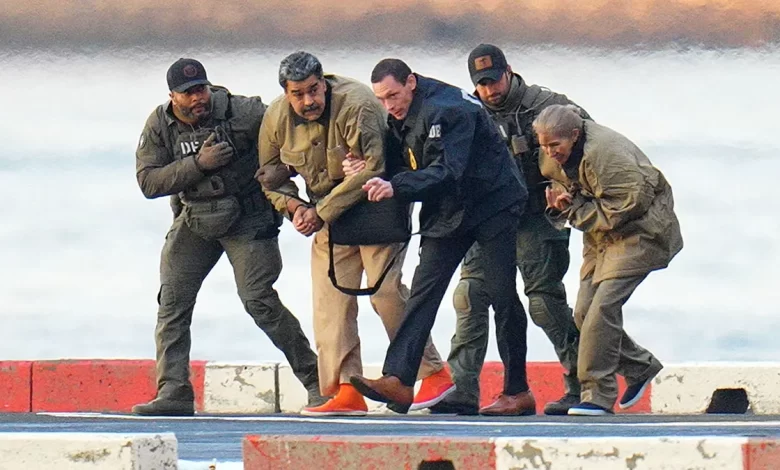
Jordan Daily – In international politics, headlines rarely tell the full story. The arrest of a head of state is never a purely legal act, nor merely a display of power. It is a revealing moment, when the curtain is lifted just enough to show how the global order actually functions: where power precedes law, and legality often follows interest.
The case of Nicolás Maduro is not simply the story of a man, but of a governing model that exhausted its margins of survival. It is also the story of a country left for years in a grey zone- neither pushed toward decisive collapse nor offered a genuine political settlement. In politics, such limbo is dangerous. Vacuums do not last; they are filled by those with patience, leverage, and the ability to wait for the right moment.
The United States did not suddenly discover that Maduro was authoritarian, nor did it abruptly complete a legal file that had been empty the day before. These facts were long established. What changed was the context: a fatigued international system, energy markets once again sensitive to disruption, and a sharpening U.S.- China rivalry that now plays out across every region, including Latin America- long assumed to be peripheral, or settled.
Seen this way, the move is less a judicial act than a message. It says that influence is not maintained by rhetoric alone, and that regimes built on permanent confrontation with Washington, without a credible shield, remain exposed when strategic calculations shift. This is not a politics of values, but a politics of enforceability.
Here, China’s unease becomes central. Beijing does not view Maduro as an ideological partner, but as a guarantor- however imperfect- of continuity. China invests in systems, not personalities, yet systems require a minimum level of stability. What occurred strikes at the core of that assumption. If the head of the system can be removed in this manner, what becomes of oil-for-debt agreements, long-term contracts, and carefully structured financial exposure?
Latin America, predictably, is divided along familiar fault lines. Left-leaning governments see in the episode the return of an old ghost: interventionism dressed in legal language, the revival of a “backyard” logic they believed buried with the last century. Others, worn down by economic collapse, migration, and institutional decay, interpret Maduro’s fall as an overdue end to an unviable model. History, however, offers little comfort to either camp. Intervention rarely manufactures democracy; more often, it creates a new and costly vacuum.
The deeper question is not whether Maduro deserved his fate, but what this episode signals about sovereignty itself. Are we entering a world where weaker states are governed by indictments and extraditions? Where international law becomes selectively operational- activated against those without deterrence, suspended before those who possess it?
In the end, what happened in Venezuela is not the conclusion of a crisis, but the opening of a more complex phase. One in which major powers test the limits of their reach, smaller states reconsider the true price of their alliances, and sovereignty becomes increasingly conditional.
As always, it is the people who remain outside the equation- paying the cost of struggles in which they have no voice, and waiting for history to confirm, once again, that politics conducted by force alone rarely ends in stability.