
By : Nedal Zubeidi
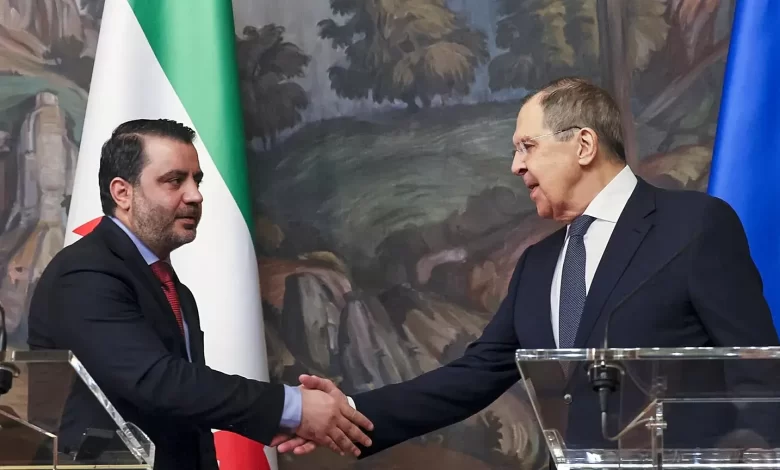
Jordan Daily – In international politics, change is not measured by the loudness of slogans but by a state’s ability to manage continuity amid disruption. What is unfolding today between Damascus and Moscow is neither a return to the past nor a clean break from it, but a calculated effort to recalibrate interests after a profound political rupture.
The fall of Bashar al-Assad marked a symbolic loss for Russia, yet it did not amount to a full strategic defeat. Moscow, which invested heavily in Syria militarily and politically for years, understands that states are built on geography and institutions, not on individuals. Syria’s location, its Mediterranean coastline, and its role in Middle Eastern power balances remain too important to abandon.
For Syria’s new leadership, revolutionary legitimacy quickly gives way to the realities of statehood. Governing requires a disciplined army, functioning institutions, and external relationships that prevent isolation. From this perspective, maintaining ties with Russia is a pragmatic choice rather than an ideological one.
The emphasis on expanding military cooperation, modernising equipment, and transferring expertise does not signal an appetite for confrontation. Rather, it reflects an acknowledgement that the post-war phase demands a professional, defensive military structure rather than improvised wartime formations. Russia’s experience in restructuring armed forces makes it a technically valuable partner, especially as Western restrictions continue to limit Syria’s access to military support.
Politically, Moscow remains a key actor at the UN Security Council, capable of blocking or enabling critical diplomatic initiatives. A new Syrian government seeking international recognition and sanctions relief cannot ignore the importance of such leverage, even if Russian support is neither unconditional nor sufficient on its own.
Economically, reconstruction poses the greatest challenge. Russia lacks the financial capacity to rebuild Syria on its own, but it offers something equally significant: access to non-Western networks and partners willing to operate outside the dominant Western sanctions framework. Cooperation in infrastructure, energy, and investment can help generate a minimum level of economic momentum.
From Moscow’s perspective, engagement with Syria’s new rulers is also a test of adaptability. While Russia lost a long-standing ally, it is signaling that influence does not have to disappear with regime change. By working with a leadership that once opposed its ally, Moscow seeks to preserve its foothold in the Eastern Mediterranean and project an image of strategic flexibility rather than rigid loyalty to individuals.
The Syrian-Russian relationship is thus entering a more transactional phase- less emotional, more analytical. It is no longer a wartime alliance built on survival, nor a patron-client relationship defined by dependency. Instead, it is a mutual assessment: Damascus testing the limits of Russian support, and Moscow evaluating the new leadership’s capacity to govern and stabilize the country.
Ultimately, the question is not whether Syria will align with Russia, but whether it can avoid over-dependence on any single power. In this delicate balancing act, Russia may be a difficult partner- but in a moment of transition, it remains one that Syria cannot afford to ignore.