
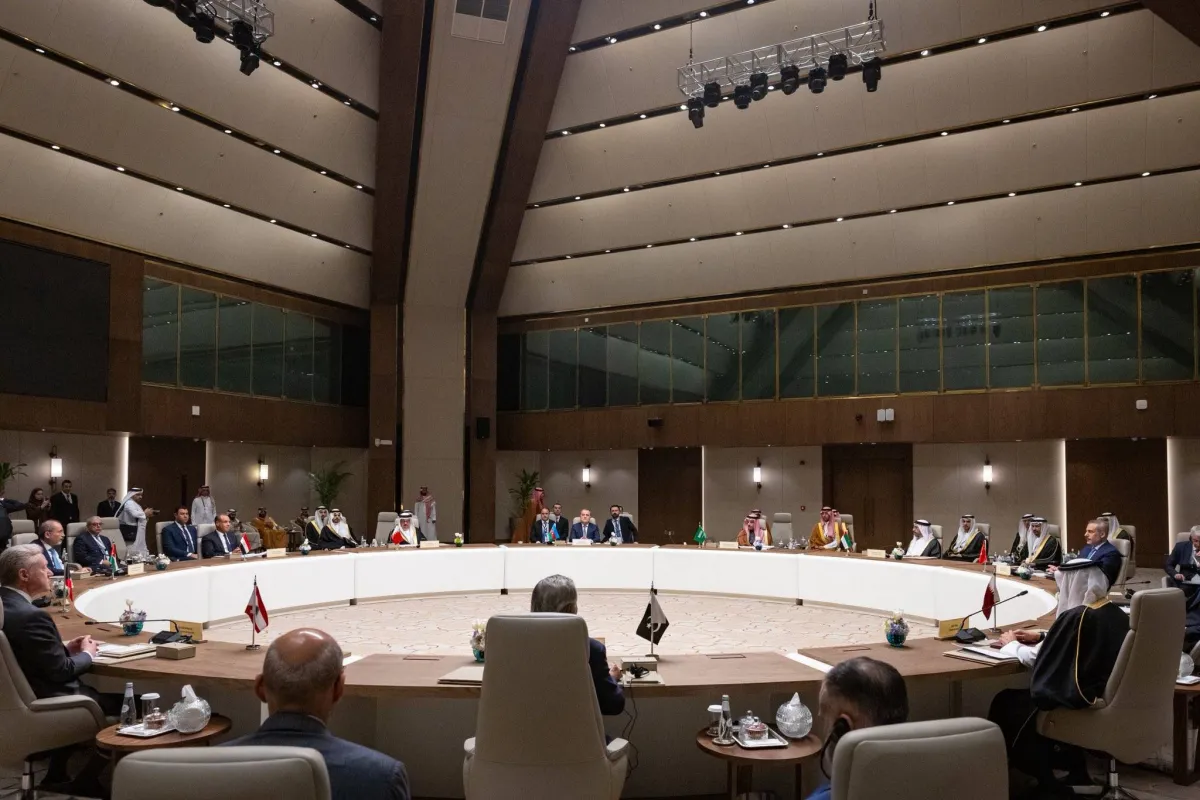
JD - A consultative ministerial meeting hosted in Riyadh has issued a strong warning to Iran, stating that its continued violation of the principles of good neighborliness and national sovereignty will have severe consequences for Iran itself and the stability of the Middle East.
The meeting, convened at the invitation of Riyadh, brought together the foreign ministers of Saudi Arabia, the United Arab Emirates, Bahrain, Qatar, Kuwait, Jordan, Egypt, Lebanon, Syria, Pakistan, Turkey, and Azerbaijan to discuss escalating tensions with Iran and to strengthen regional coordination to protect the area's stability.
The ministers condemned the attacks on Gulf states, Jordan, Azerbaijan, and Turkey. They also denounced the targeting of residential areas and civilian infrastructure, including oil installations, water desalination plants, airports, residential complexes, and diplomatic missions.
The attendees asserted that the Iranian attacks are unjustifiable under any pretext and constitute a violation of sovereignty and international law. They held Tehran fully responsible for the damages and affirmed the right of affected countries to defend themselves in accordance with Article 51 of the United Nations Charter.
The meeting participants emphasized the danger of supporting militias and destabilizing security. They called on Iran to seriously reconsider its miscalculations, immediately cease its aggression, and adhere to UN Security Council resolutions.
In a joint statement, the ministers called on Iran to respect international and humanitarian law and the principles of good neighborliness as a first step toward de-escalation, achieving regional security and stability, and activating diplomacy to resolve crises.
The ministers affirmed that the future of relations with Iran depends on its respect for the sovereignty of states and non-interference in their internal affairs. They also stressed that Iran should not infringe on their sovereignty or territories in any way or use its military capabilities and development to threaten countries in the region.
The statement emphasized the need for Iran to comply with Security Council Resolution 2817, immediately cease all attacks, and refrain from any provocative actions or threats directed at neighboring countries. It also demanded that Iran stop supporting, financing, and arming affiliated militias in the Arab region, which it does in service of its goals and against the interests of states.
The ministers also called on Iran to refrain from any actions or threats aimed at closing or obstructing international navigation in the Strait of Hormuz or threatening maritime security in Bab al-Mandab.
The participants reaffirmed their support for the security, stability, and territorial integrity of Lebanon, the activation of Lebanese state sovereignty over all its territories, and support for the government's decision to confine weapons to the state. They also expressed their condemnation of Israeli aggression against Lebanon and its expansionist policies in the region.
The ministers renewed their determination to continue intensive consultation and coordination in this regard to follow up on developments and assess developments to ensure the formulation of common positions and take whatever legitimate measures and actions are necessary to protect their security, stability, and sovereignty and stop the criminal Iranian attacks on their territories.