
Jordan Daily - UNESCO and the Government of Italy have launched a €2 million project to conserve Petra’s Palace Tomb, one of the ancient city’s most prominent rock-cut façades. Funded by Italy the project will combine priority conservation work with on-the-job training to strengthen Jordanian expertise in the monument’s long-term care.
Over 24 months, UNESCO will work with the Petra Development and Tourism Region Authority (PDTRA) and Jordan’s Department of Antiquities to update the conservation plan developed during the first Italian-funded phase and carry out targeted restoration, consolidation and reinforcement works at the Palace Tomb.
The Palace Tomb combines rock-cut architecture with freestanding masonry and faces structural instability, water infiltration and weathering. The project will prioritise urgent stabilisation measures in high-risk areas, helping to preserve the monument and improve visitor safety.
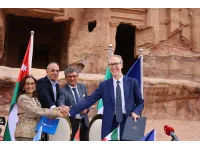
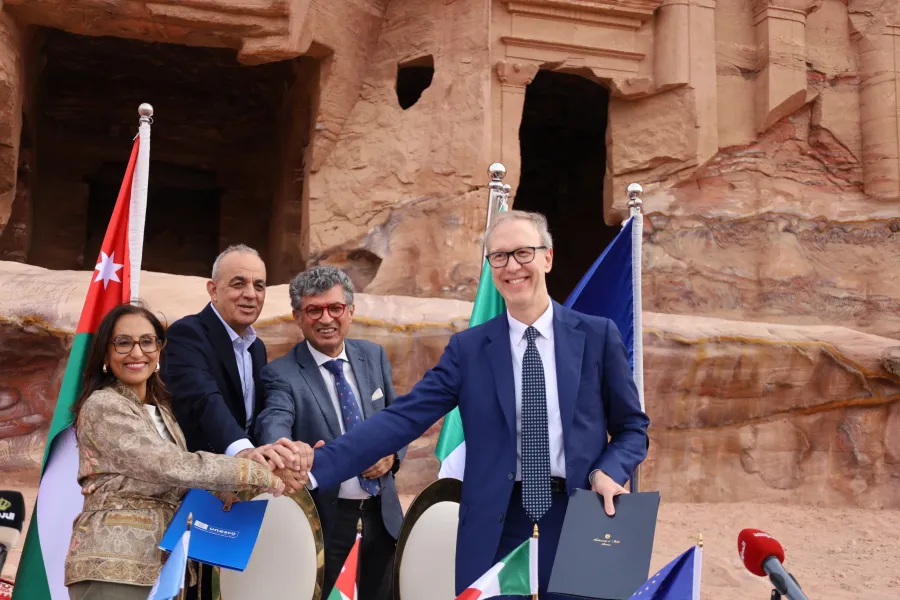
Pier Luigi Zamporlini, Ambassador of Italy to Jordan, and Noha Bawazir, UNESCO Representative to Jordan and Head of Office, signed an Arrangement for the project at a ceremony in Petra. The ceremony was attended by Dr. Imad Hijazin, Minister of Tourism and Antiquities, Dr. Adnan Al Sawair, Chief Commissioner of the Petra Development and Tourism Region Authority (PDTRA), and the Jordan National Commission for Education, Culture and Science.
Zamporlini reaffirmed Italy’s commitment to cultural heritage preservation and international cooperation.
"Petra belongs to Jordan, but its beauty, history and universal value speak to the whole of humanity. Italy is honoured to stand alongside Jordan, in partnership with UNESCO, in preserving this extraordinary archaeological heritage and ensuring that it can be safeguarded for generations to come. At the same time, this project looks to the future by investing in Jordanian expertise, young professionals and local communities, and strengthening the capacities needed to protect and enhance the country’s remarkable cultural heritage. This initiative is a further expression of the longstanding partnership between Italy and Jordan and of our shared belief that cultural heritage can be a powerful driver of sustainable development, opportunity and dialogue".
Noha Bawazir, UNESCO Representative to Jordan and Head of Office, highlighted the project’s contribution to conservation and Jordanian expertise:
“Today’s agreement builds on the longstanding partnership between UNESCO and the Government of Italy to conserve Jordan’s cultural heritage. It reflects our shared commitment to protecting Petra’s Outstanding Universal Value. Together with Jordanian authorities, our partners and Petra’s local community, we are investing in the sustainable conservation of the Palace Tomb and in the skills of people who care for it. By combining conservation work with hands-on training at the site, we are strengthening the Jordanian expertise needed to care for the monument over the long term, so that future generations can continue to learn from Petra and draw inspiration from it.”
The project comes at a challenging time for tourism and the livelihoods of communities that depend on Petra, underscoring the importance of conserving a heritage site central to the local economy.
Members of Petra’s local communities will be employed in the conservation works and receive practical training under specialist supervision. Alongside training for national authorities and emerging conservation professionals, this will connect the monument’s preservation with local employment and skills development.
Through this project, UNESCO, Italy, and Jordanian institutions are supporting Petra’s conservation and sustainable management and safeguarding its Outstanding Universal Value.