

Dr. Fadi Maayah
Curtin University , Australia
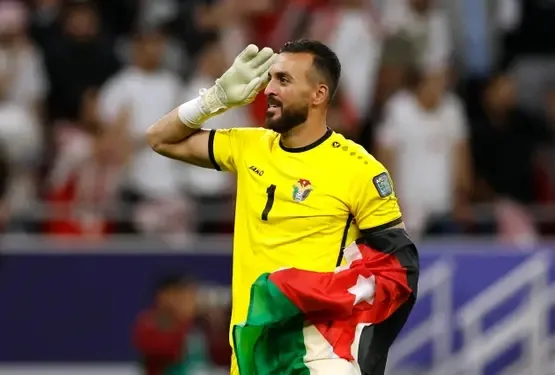
Jordan Daily - As Jordan's FIFA World Cup 2026 campaign came to an end, much of the criticism directed at goalkeeper Yazeed Abu Laila followed a familiar pattern. Social media, commentators and sections of the media quickly pointed to the goalkeeper as the primary reason for Jordan's results. Yet this reflects one of football's most persistent misconceptions: because goalkeepers are the last line of defence, they often receive the blame for goals regardless of the events that occurred beforehand.
The problem with much of today's football analysis is that it focuses on the outcome rather than the process. A goal is scored, and attention immediately shifts to the goalkeeper. What is often overlooked is that goals are rarely the result of one isolated mistake. More commonly, they are the product of a chain of technical, tactical and decision-making factors involving multiple players.
One of the greatest misconceptions in elite sport is that performance is determined on match day. It is not. Match day simply reveals the product of weeks, months and sometimes years of preparation. Coaches, analysts, sports scientists and support staff spend countless hours preparing players for specific opponents, tactical scenarios and set-piece situations. In modern football, every goal conceded is analysed not to assign blame, but to understand what happened and how improvements can be made.
When evaluating Yazeed Abu Laila's World Cup performances, context matters.
Against Austria, Jordan faced four corners and Abu Laila recorded a save. Austria's victory was influenced by an own goal from a corner situation and a late penalty rather than a clear goalkeeping error. Austria generated higher-quality scoring opportunities and capitalised on key moments.
Against Algeria, Jordan came under sustained pressure. Algeria dominated possession with 75 per cent of the ball, produced 17 shots, eight shots on target and won 10 corners compared with Jordan's one. Despite that pressure, Abu Laila made five saves and kept Jordan competitive for much of the match. More importantly, Algeria's two goals came from corner kicks after Jordan lost crucial aerial duels inside the penalty area. Those goals reflected collective defensive issues involving marking, positioning and first-contact responsibilities rather than obvious goalkeeper mistakes.
The criticism intensified following Jordan's final group match against Argentina. However, the statistics again tell a broader story. Argentina controlled 73 per cent possession, won six corners compared with Jordan's two and scored from two direct free kicks and a penalty rather than open play. Abu Laila also recorded a save while facing one of the most technically gifted teams in world football.
Much of the attention focused on Giovani Lo Celso's free-kick goal. Some supporters argued that Abu Laila moved too close to the defensive wall and left space at the near post. Yet a deeper tactical analysis presents a more complete picture. Reports indicate that Argentina deliberately positioned players to obstruct Abu Laila's vision and make it difficult for him to track the ball's flight. This was not simply a goalkeeping mistake; it was a carefully rehearsed set-piece strategy by the reigning world champions. To view the goal solely through the lens of goalkeeper error ignores the quality of Argentina's planning and execution.
Across Jordan's three group matches, Abu Laila recorded at least seven saves while facing Austria, Algeria and Argentina. Jordan defended 20 opposition corners, including 10 against Algeria alone. The goals conceded came from an own goal, two corner kicks, a penalty, two direct free kicks and one open-play strike from outside the box. These numbers demonstrate that Jordan's defensive challenges extended well beyond one player.
It is also important to remember that mistakes are part of football, even at the highest level. Roberto Baggio missed the decisive penalty in the 1994 FIFA World Cup Final. Diego Maradona missed a penalty at the 1990 World Cup and Lionel Messi missed a penalty against Iceland at the 2018 World Cup. These moments did not define their careers. They are remembered for their achievements, resilience and ability to respond to adversity. The same principle applies to goalkeepers. At the highest level, where margins between success and failure are incredibly small, mistakes are inevitable. History provides many examples. Robert Green's handling error for England against the United States in 2010, Oliver Kahn's spill in the 2002 World Cup Final, Willy Caballero's misplaced pass for Argentina in 2018, and René Higuita's famous mistake against Cameroon in 1990 are all reminders that even elite goalkeepers can make errors on football's biggest stage.
From a performance analysis perspective, goalkeepers are assessed across multiple areas, including positioning, decision-making, handling, distribution and communication. Analysts do not simply blame the goalkeeper because a goal is scored. They examine the tactical context, the actions of surrounding players and the sequence of events that created the opportunity. Looking only at the scoreboard provides an incomplete picture.
This is why the criticism directed at Yazeed Abu Laila is not fair and deserves greater balance and perspective. Football is a team sport. Goals are rarely the responsibility of one individual, just as victories are rarely achieved by one player alone. Modern football is built on continuous learning, reflection and improvement.
Before judging Yazeed Abu Laila, supporters and analysts should look beyond the outcome and examine the whole picture. Football is far more complex than a single goal, a single save or a single moment. Understanding the process, rather than reacting only to the result, is what separates genuine football analysis from emotional criticism. Ultimately, that is the fairest way to assess both the player and the performance.