
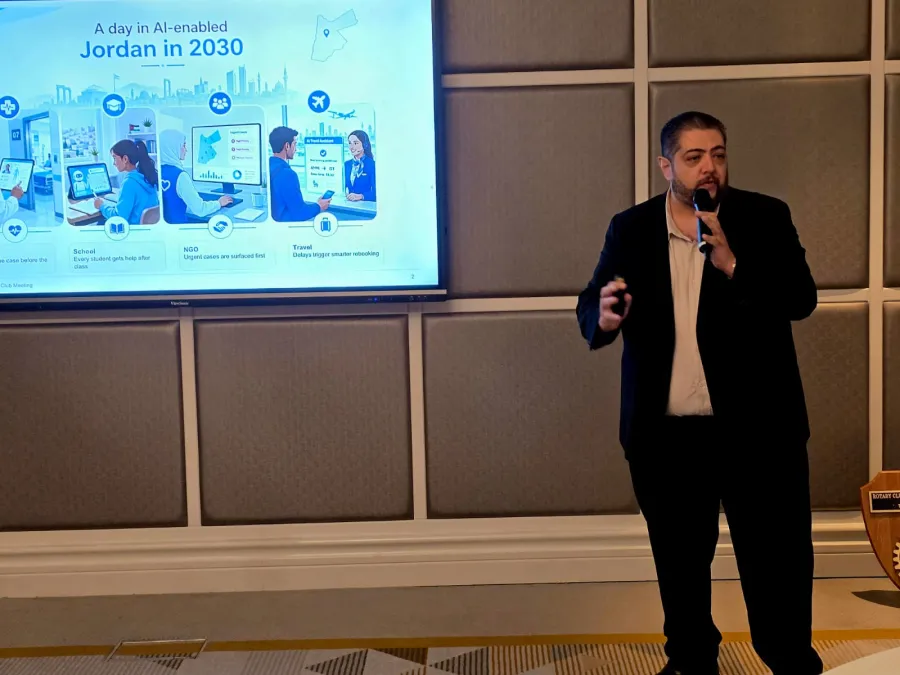
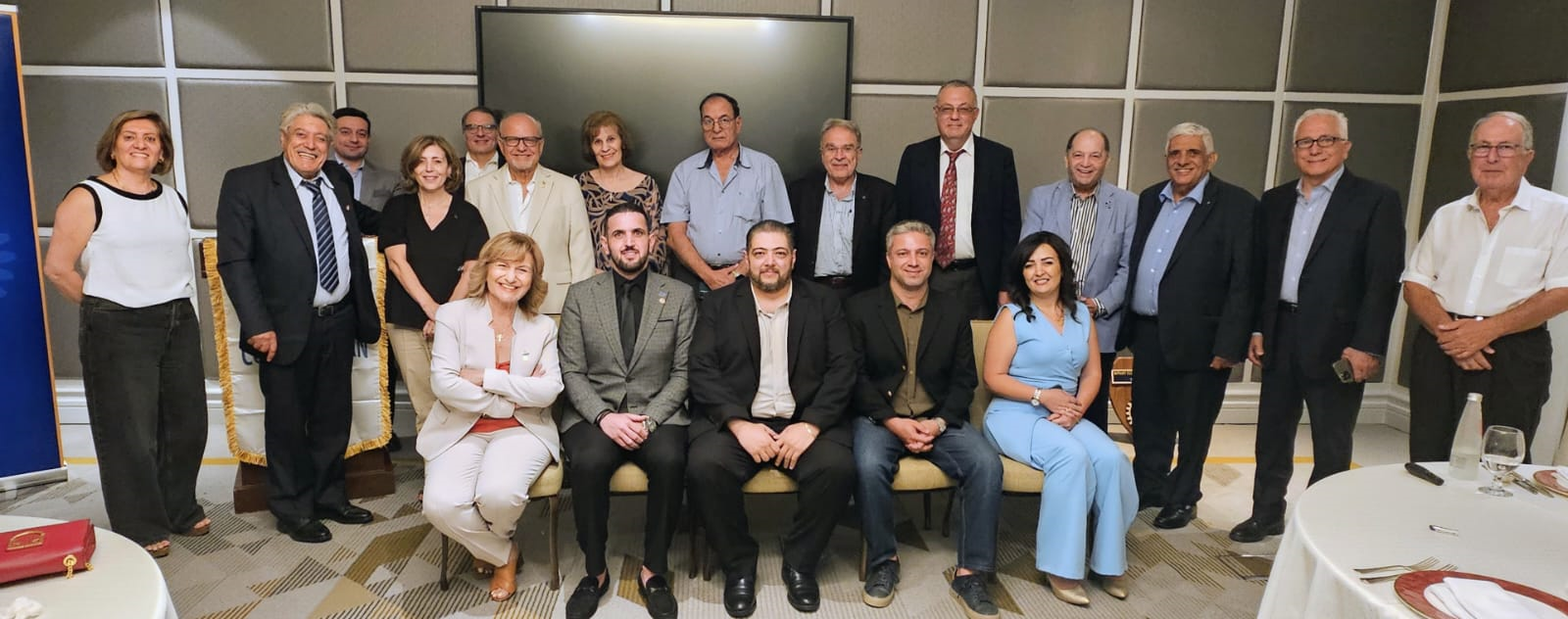
Jordan Daily - 'Artificial Intelligence can be helpful or harmful it all depends on how it is used." That was how AI expert Raed Nesheiwat opened his lecture at the Amman Cosmopolitan Rotary Club Wednesday, August 12, at the Four Seasons Club.
Nesheiwat delivered a wide-ranging presentation on how artificial intelligence is expected to reshape Jordanian society, focusing on education, healthcare, NGOs, tourism and travel, and the future of work.
From the outset, Nesheiwat urged the audience which also included club co-sponsors Amman Philadelphia Rotary to picture daily life in Amman a few years from now, around 2030. He described a scenario in which AI is deeply embedded in routine services. In healthcare, he said that when a patient arrives at a hospital, the doctor would immediately have access to the patient's medical records and history, an analysis of symptoms, and possible diagnoses with confidence levels even before speaking with the patient. He explained that this would allow clinicians to focus more quickly on decision-making and patient care rather than spending early time collecting information.
The event which was Nesheiwat also described how AI would transform classrooms. He envisioned every student working from a tablet or device with AI capabilities that visualize and explain concepts in ways personalized to each learner's needs. In this scenario, once class ends, the AI tutor continues supporting the student by identifying their challenges and strengths and adjusting learning accordingly.
In the realm of NGOs and social work, Nesheiwat said organizations often manage large numbers of cases accompanied by extensive documentation and reporting requirements. He argued that by 2030, AI could classify and process large volumes of cases in minutes rather than the weeks and months it may take today, and could identify where interventions are needed. He emphasized that this would shift efforts from reacting after problems occur to predicting issues earlier and acting before crises deepen.
He extended the same logic to travel and customer services. Using the example of an airline cancelation flooding offices with phone calls, Nesheiwat said AI could automatically rebook passengers onto alternative flights that suit schedules and preferences. The intent, according to his vision, is to reduce delays and improve decision speed when disruptions occur.
The lecture then moved to how humanity reached this point. Nesheiwat described the evolution from the internet era in the 1990s, when professionals relied on search engines and online information to understand problems, to the emergence of generative AI in late 2022, such as ChatGPT, which can draft answers and suggestions directly from user prompts. He described a further evolution into AI agents, which not only respond to questions but can carry out multi-step tasks. He said these systems can research issues, compile reports and presentations, draft emails, follow up on responses, and handle customer interactions, effectively bridging the gap between information and execution.
Addressing Jordan specifically, Nesheiwat noted that the country historically competed with the Gulf region in sectors such as IT and communication, benefiting from regional demand and a strong base of talent and software services. However, he argued that AI changes the competitive landscape. He referenced an index measuring government readiness to adopt AI across 195 countries and said Jordan ranks 63, while countries such as the UAE and Saudi Arabia rank much higher. He said Jordan cannot match the region by spending power alone, and may not be able to build the same scale of data centers or develop AI models at the same speed.
Despite this, Nesheiwat argued that Jordan still has a clear opportunity. He pointed to the country's young, educated population and its potential to use open models to develop AI services domestically. He explained that AI systems can be deployed in different forms. He contrasted closed models controlled by large companies, which users access through subscriptions, with open models that can be run on local servers and adapted by governments and organizations. He described open models as enabling institutions to customize systems for local needs while keeping greater control over infrastructure and use.
Nesheiwat warned that Jordan must act quickly and strategically, because the time between emerging technologies and their widespread adoption can be short. In his view, the window for shaping how AI is used in Jordan depends on building capacity rather than only consuming tools developed abroad.
He then discussed practical examples of AI impact across sectors. In healthcare, he highlighted not just administrative uses but also diagnostic and research implications. He referenced how AI can assist radiology by reading CT scans and MRIs and improving accuracy, and suggested that AI-enhanced detection could lead to fewer misdiagnoses. He also mentioned the broader healthcare ecosystem, including patient records, customer service analytics, and hospital performance dashboards.
He also addressed how AI is changing travel and hospitality through personalization. Drawing from work in consumer-facing services, he described how AI can track customer behavior and preferences to tailor experiences and offers, and how systems can recognize when a customer has not visited for a period and send personalized outreach with incentives.
In education, he argued that schools must adapt because AI changes the meaning of homework and student evaluation. If AI can answer problems, he said the value must shift toward projects, reasoning, and defending sources rather than memorization. He suggested that universities and schools should move away from relying on detection of AI use and instead redesign assessments so that students demonstrate understanding through real work and critical thinking.
Nesheiwat also tackled concerns about employment. He said some jobs will be displaced or become fully automated, particularly those involving repetitive tasks. However, he emphasized that most work will be reshaped rather than simply eliminated. In his view, the key is AI literacy—treating learning AI skills as foundational as learning computer skills—so people become users and supervisors of AI rather than victims of replacement.
He described a concept he applied in his own company: developers using AI tools to help with coding tasks, while their role becomes oversight and translating what the system should do. He said this approach can shorten timelines significantly.
The lecture concluded with a call to action. Nesheiwat urged participants to examine their organizations and identify manual, time-consuming tasks that could potentially be automated over the next 30 days. He described a pathway from individuals using AI for personal productivity to teams collaborating through shared workflows, and eventually toward organizations operating with AI agents that can handle tasks continuously with minimal human input. He stated that as organizations become more AI-native, society becomes more prepared for the transformation.
Throughout the evening, Nesheiwat's message centered on the need for preparedness. AI will transform society, but the outcome for Jordan depends on whether institutions and individuals respond with speed, strategic planning, and investment in capability. He argued that the future question for Jordan is whether it will remain an AI consumer or develop into an AI producer.