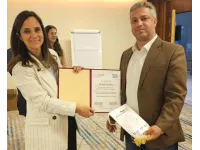

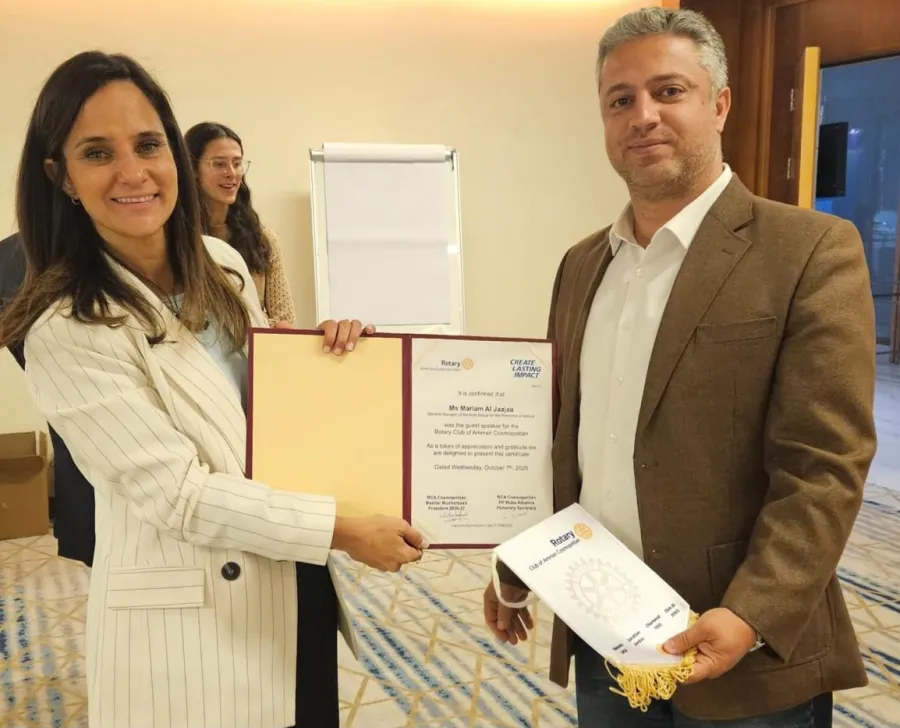
Jordan Daily - The General Manager of the Arab Group for the Protection of Nature (APN), Mariam Al Jaajaa, called for a focus on food sovereignty instead of food security. She made the call during a lecture on the close relationship between environmental protection and sustainable development, and on the role of civil society and institutions in turning environmental awareness into concrete policies and practices.
The lecture at the Rotary Club of Amman Cosmopolitan on Wednesday, October 7, highlighted the region's accumulated environmental challenges, foremost among them climate change, environmental degradation, biodiversity loss, and increasing pressure on natural resources.
Jaajaa defined nature as an integrated system that extends beyond parks and reserves, encompassing everything that surrounds humanity: water, soil, food, air, and the ecosystems that support human, animal, and plant life. She emphasized that protecting nature is not a cultural luxury but an existential necessity, as any disruption to the environment directly impacts public health, the economy, and social stability. In this context, she stressed that the Arab region faces complex environmental challenges: the hot, arid climate exacerbates the fragility of water resources, while urban growth and rising demand for energy and water drive up consumption and put pressure on natural systems.
The lecturer noted that biodiversity loss is one of the most serious consequences of encroaching on natural habitats, whether through uncontrolled urban expansion, deforestation, pollution, or unregulated hunting. 2Jaajaa explained that different species are not merely aesthetic elements of nature; they play vital environmental and economic roles. Pollinating insects, for example, support food production. Healthy ecosystems help regulate the water cycle and mitigate floods and droughts. Without these balanced roles, costs to societies rise, and the likelihood of environmental and health crises increases.
Regional work in Palestine and Lebanon
Jaajaa spoke about APN’s presence in Palestine, with a team in Gaza and another in the West Bank. “From there, our work began to expand to include Lebanon as well. In addition, we have work at the regional and international levels.”
APN’s work relies heavily on volunteering, along with the support and participation of large companies and grassroots organizations. “We also sometimes collaborate with private sector institutions and government entities. Our work is related to the concept of food sovereignty, and I was asked to elaborate further on this topic.”
Food sovereignty differs from food security. Food security focuses on ensuring food availability and access to it. This is why all UN agencies emphasize food security. Food security, on the other hand, primarily means access to food, regardless of whether it is imported or locally produced. “The difference is that food sovereignty relies on the fact that food is linked to its production and availability: who produces it, where it comes from, and where the capacity to produce it is located.”
Jaaja argued that a person may be in dire circumstances but still enjoy food security if someone provides a continuous supply. However, the "food sovereignty" we are discussing is the foundation of economic and political sovereignty. It grants societies genuine resilience during economic, health, or political crises, or when borders are closed. This is painfully evident in what we are witnessing in Gaza: under siege and in the harshest of conditions.
They uprooted a tree; we plant ten
The APN project in Palestine is called the "Million Tree Campaign. " Perhaps not everyone has heard of it, but our slogan was " For every tree they uproot, we plant ten." The project began in 2000 with the planting of the first million trees. The second million was planted in 2014, and the third million were planted about a year ago. APN also planted over 270,000 fruit trees in Jordan within the Green Caravan Program in collaboration with 12000 farmers
These trees were planted in cooperation with approximately 38,000 farmers across historic Palestine, in addition to many other projects in related fields such as water and agriculture projects. These projects are taking place in challenging areas, such as Areas “B &C”. A large percentage of the West Bank falls within areas classified as “C,” or agricultural areas, and some villages are effectively besieged by large numbers of settlers.
Two years ago, APN started a project targeting besieged villages, aiming to achieve self-sufficiency as much as possible. The number of houses in a village can vary; some villages have around fifty houses, while others are much larger: two thousand, three thousand, or even four thousand. What APN is doing is introducing household and community systems that ensure sustainability, such as... Water storage tanks, irrigation systems, and poultry farming projects. The goal is to have all the necessary elements in place so people can continue their lives and production even if the street is closed, movement is restricted, roads are repeatedly closed, or successive restrictions are imposed.
In Gaza, over the past two years, APN has begun reviving the agricultural sector to strengthen people’s ability to survive and prevent the collapse of their livelihoods, in line with the concept of food sovereignty.
The general manager of APN commented on the concept of “nature-based solutions” and how they can reduce environmental risks. These solutions focus on using ecosystems themselves by supporting biodiversity and managing resources sustainably, rather than relying on costly measures or partial solutions that do not address the root causes. She explained that restoring green spaces, protecting valleys and water sources, and enhancing vegetation cover can reduce the effects of floods and fires and limit soil erosion. Furthermore, proper waste management and reducing pollutants in water and soil can preserve both environmental quality and public health.
Jaja addressed the challenge of widespread pollution, particularly water and air pollution. In major cities, emissions from vehicles and industry are linked to deteriorating air quality, which in turn leads to respiratory and cardiovascular diseases. In rural areas, poor waste management or unsustainable agricultural practices can result in soil degradation and groundwater contamination. She emphasized that pollution is not just an environmental issue, but also a social, health, and economic one, because public health is a fundamental resource no less important than water or food.
From awareness to action
One of the lecture's key messages was the need to move from "awareness" to "action." Environmental conditions do not change simply through seasonal campaigns or public statements; rather, they require a comprehensive system of action that includes environmental education, community engagement, support for grassroots initiatives, and effective regulatory frameworks. Jaja pointed out that educational, media, and civil society institutions can play a significant role in building a sustainable environmental culture among new generations, so that preserving nature becomes part of daily behavior, not just a slogan.
The lecture also emphasized the role of partnerships between different sectors. Addressing challenges such as climate change and protecting natural habitats requires cooperation among government agencies, the private sector, civil society, and universities and research centers. Environmental organizations, as the lecture notes, serve as a link between scientific knowledge and the field's needs. These organizations document environmental problems, monitor changes, implement awareness and practical programs, and advocate for policies that respect nature's boundaries and its capacity for regeneration.
In this context, Jaaja linked nature protection and human security. Environmental crises can escalate into humanitarian crises when basic services, such as clean water, deteriorate, or when droughts and desertification increase. When natural resources become scarce, the likelihood of conflicts over land or water sources rises. Therefore, investing in environmental protection is an investment in societal stability, not merely a reactive measure after damage has occurred.
APN’s Jaajaa concluded her lecture with a clear message: protecting nature is possible with will, awareness, and collective action. She called for strengthening initiatives that protect biodiversity, reduce pollution, and promote responsible resource consumption. She also emphasized that changing course begins with daily decisions at the individual and institutional levels, and with national policies that embrace sustainability and ensure the implementation of environmental laws.
A lively and important discussion followed the lecture. It reflected local community institutions' growing interest in environmental issues, emphasizing that cultural and humanitarian platforms can become effective channels for sharing knowledge and encouraging participation.
As the gap widens between environmental challenges and society’s ability to address them, it becomes increasingly important that calls for nature protection be accompanied by practical plans, ranging from awareness to legislation to implementation, leading to a healthier and more sustainable society for future generations.