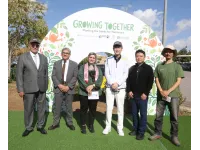

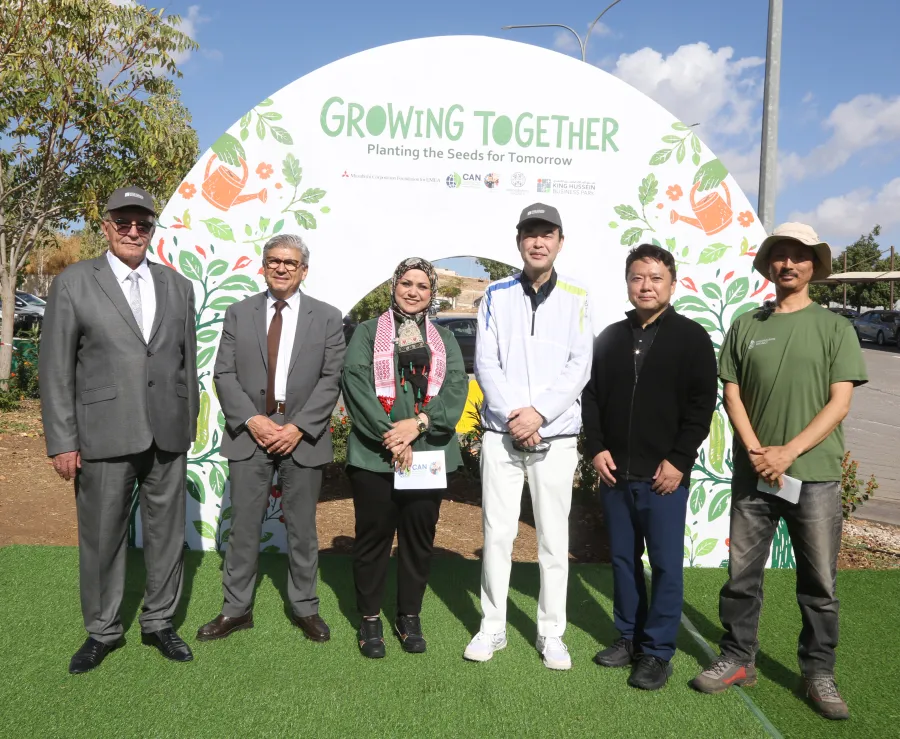
Jordan Daily - The launch ceremony of the Japanese Miyawaki Forest planting activities and the inauguration of a greywater reuse system was hosted at King Hussein Business Park (KHBP) as part of the ‘Establishment of a Miyawaki Forest and Greywater Reuse System’ project, funded by the Mitsubishi Corporation Foundation for EMEA , implemented by the Climate Action Association in Jordan (CAN) in collaboration with the Midorization Project.
The ceremony brought together representatives from government entities, development partners, diplomatic missions, the private sector and environmental stakeholders to celebrate a pioneering initiative that combines sustainable water management and urban afforestation.
Adopting the Japanese Miyawaki methodology, the project will establish a dense urban forest of Jordan’s native plants, including several rare and endangered species. The initiative is expected to enhance biodiversity, improve air quality, expand green cover and contribute to a healthier and more resilient urban environment.
The project also comprises a greywater treatment and reuse system that supports sustainable water management by providing an alternative water source for landscape irrigation and other non-potable uses. The system reduces dependence on freshwater resources and encourages more efficient water use in one of the world's most water-scarce regions.
Alongside its on-the-ground work, the project features awareness-raising and capacity-building activities aimed at fostering environmental stewardship, highlighting the importance of sustainable natural resource management and encouraging community engagement in environmental and climate initiatives.
Commenting on the launch, Eng. Doa’a Al-Derabani, CAN CEO, said, “At the Climate Action Association in Jordan, we believe that building a more sustainable future requires investing in practical solutions that combine responsible natural resource management with community resilience. This project represents an integrated model that brings together sustainable water management and urban greening, demonstrating how strong partnerships can transform environmental ambitions into tangible impact that enhances quality of life and contributes to more sustainable cities for future generations.”
For his part, Eng. Ammar Izziddin, KHBP CEO, noted, “Around a year and a half ago, we began aligning our practices at KHBP with environmental, social and governance (ESG) standards, driven by our belief that environmental sustainability is a cornerstone of our vision for the future. This project is one of a series of initiatives and steps we are taking to advance eco-friendly practices, expand green spaces and use resources more efficiently, helping to build a more sustainable business environment.”
Motoharu Nochi, the Midorization Project Founder, stated, “Nothing in nature exists alone, and neither do we. We depend on each other and thrive through collective effort. Today, students, partners and members of the community have come together to plant this urban forest in the heart of Amman, using native species that are part of Jordan’s natural heritage. Many of these plants once grew throughout the Kingdom’s forests, but have become increasingly rare, with some now threatened with extinction. By planting them, we are helping restore part of what has been lost, while bringing people closer to the land and encouraging a shared responsibility to care for and protect the natural environment we call home.”
The project demonstrates a shared commitment to advancing practical environmental solutions that support biodiversity conservation, water sustainability, climate change adaptation and the creation of greener, more sustainable urban spaces for future generations.