
Jordan Daily - Heightened tensions in the Middle East have drawn renewed attention to the Strait of Hormuz, a critical waterway for global oil exports. This narrow passage connects major oil-producing nations to key markets worldwide, making it a strategic chokepoint susceptible to geopolitical pressures.
The Strait's significance lies in its role as the primary transit route for oil from Persian Gulf nations. Any disruption to traffic through the Strait could have significant repercussions on global energy markets, potentially leading to price increases and supply shortages.
Located between Oman and Iran, the Strait of Hormuz links the Persian Gulf to the Gulf of Oman and the Arabian Sea. Its narrowest point is approximately 33 kilometers (21 miles) wide. Navigational lanes are even more constricted, with inbound and outbound traffic passing through channels only about 3 kilometers (1.9 miles) wide in each direction.
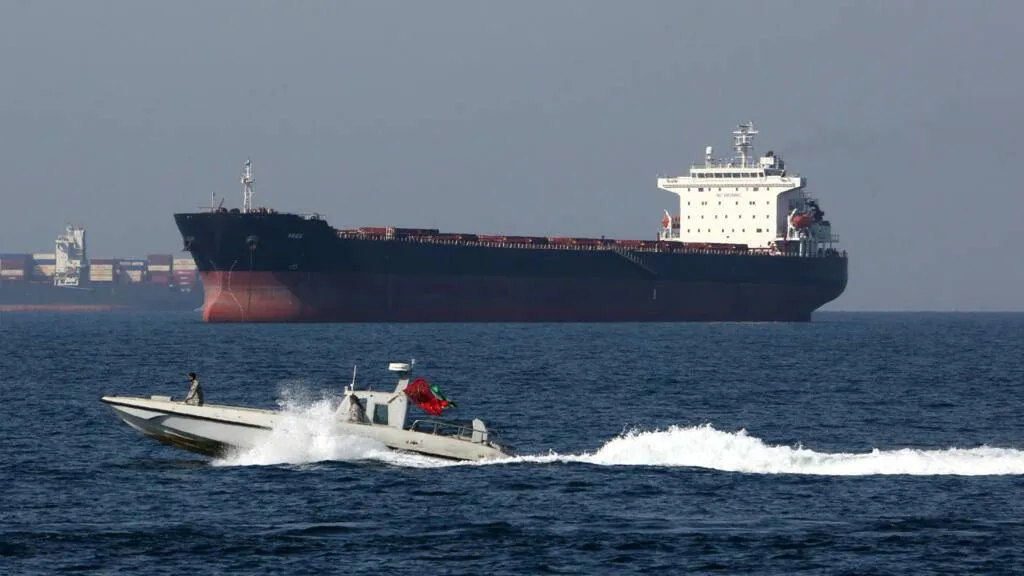
This limited width, combined with the heavy traffic volume, makes the Strait a potential bottleneck. The presence of numerous oil tankers and other vessels increases the risk of accidents and disruptions, further highlighting the waterway's vulnerability.
The U.S. Fifth Fleet, based in Bahrain, is tasked with ensuring the safety of commercial shipping in the region, underscoring the importance of the Strait to international security and trade.
Approximately one-fifth of the world's total oil consumption passes through the Strait of Hormuz. Data indicates that over 20 million barrels of crude oil, condensates, and fuels transit the Strait daily.
Major oil-producing nations such as Saudi Arabia, Iran, the United Arab Emirates, Kuwait, and Iraq rely on the Strait to export the majority of their crude oil, particularly to Asian markets. Qatar, a leading exporter of liquefied natural gas (LNG), also ships nearly all of its LNG production through the Strait.
Recognizing the potential risks associated with relying solely on the Strait, Saudi Arabia and the UAE have explored alternative routes to bypass it. The U.S. Energy Information Administration has noted the existence of unused pipeline capacity within Saudi Arabia and the UAE that could potentially transport a significant volume of oil, providing a partial alternative to the Strait of Hormuz.
In recent years, Iran has been involved in seizing ships near or within the Strait of Hormuz. These actions have often been linked to the seizure of tankers connected to Iran by the United States, highlighting the complex geopolitical dynamics at play in the region.
Past events have raised concerns about the potential for Iran to close the Strait in response to perceived threats or provocations. Such a closure would have a devastating impact on global oil supplies and would likely trigger a major international crisis.
The Strait of Hormuz remains a critical artery for the world's energy supply. Its strategic location and the volume of oil that passes through it make it a focal point of geopolitical tensions. Any disruption to traffic through the Strait would have far-reaching consequences for global energy markets and international security.