
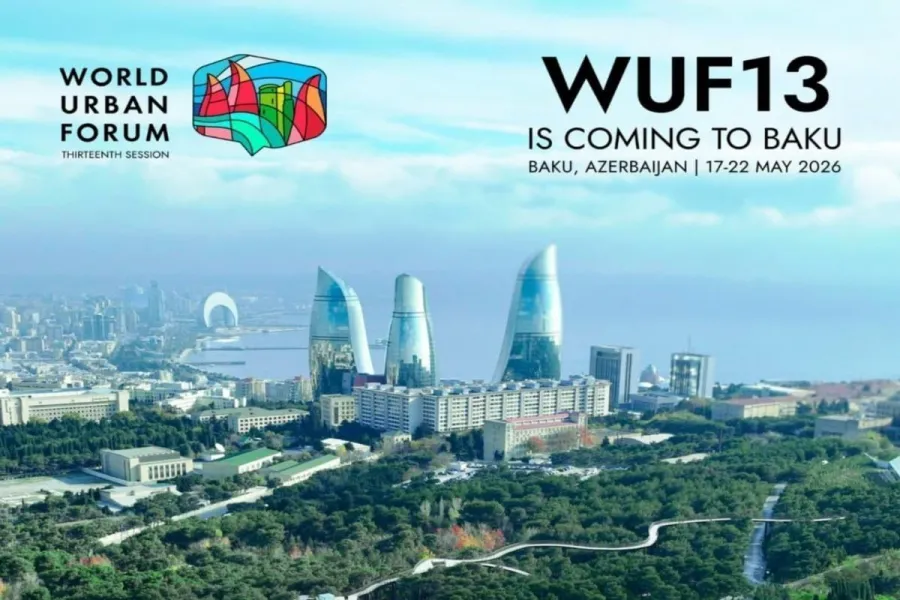
Jordan Daily - In May 2026, Baku will assume a prominent global role by hosting the 13th session of the World Urban Forum (WUF 13) from May 17 to 22. This major event will bring together policymakers, experts, leaders, and innovators to discuss global urban challenges and focus on addressing the most pressing issues facing cities today.
"Providing safe, inclusive, and sustainable housing amid rapid Urbanization"
The world is witnessing unprecedented urban expansion, with more than half of its population now living in cities under mounting pressures. This rapid growth is leading to the spread of informal settlements and depriving billions of people of adequate housing, while infrastructure faces immense strain. Climate change further exacerbates these crises through floods, droughts, and heatwaves, multiplying the challenges to sustainable development.
The 13th World Urban Forum will be held in Baku under the theme “Housing for All: Safe and Resilient Cities.” The discussions will focus on expanding affordable housing, strengthening climate resilience, mobilizing financing, and developing innovative urban design tailored to regional specificity.
The World Urban Forum is recognized as the largest UN platform for sustainable urban development. It is not merely a technical conference but a space that brings together diverse actors at multiple levels. Its strength lies in the diversity of participants — from national governments and city administrations to civil society organizations, youth, investors, and architects — reflecting the growing awareness that housing and urban management are global issues tied to social justice, climate, and the economy. The upcoming World Urban Forum in Baku (2026) is expected to mark a turning point in political engagement.
For the first time, the forum will host a Leaders’ Summit, bringing together heads of state and government. This milestone underscores the growing recognition that housing and urban management are no longer secondary technical issues, but rather fundamental pillars of national development strategies and a central element of global stability.
The world, particularly in Africa, Asia, Latin America, and parts of the Middle East, is facing unprecedented urban challenges. Rapid urban growth intersects with weak infrastructure, limited resources, and vulnerability to climate change and the spread of informal housing, limited municipal revenues, and the difficulty of accessing international financing all intensify urban crises. These factors place cities under double pressure: on one hand, they must strive to achieve sustainable development, and on the other, they must ensure social justice.
For many developing countries, the World Urban Forum provides a unique space to showcase their experiences and actively participate in shaping international debates on urban policy. The engagement of cities from the Global South has reinforced the forum’s role as a platform for inclusive dialogue and knowledge exchange, moving away from one‑directional policy prescriptions. The discussions at the 13th World Urban Forum are expected to focus on urban financing, climate change adaptation mechanisms, and the formulation of practical policies that directly address the needs of rapidly growing urban centers.
The convening of the 13th World Urban Forum in Baku represents a landmark moment for Azerbaijan and a strategic opportunity to showcase its vision for urban development. The forum will bring together experts and decision-makers from across the globe, offering the country a platform to highlight its model of balancing historical heritage with modern urbanization. Baku embodies this balance through its rich historical heritage, most notably the walled city of Icherisheher, with landmarks such as the Maiden Tower and the Palace of the Shirvanshahs. Beyond Baku, Azerbaijan’s cultural depth is reflected in sites like the Historic Centre of Shaki with the Khan’s Palace, and the Gobustan Cultural Landscape, famous for its ancient rock arts.
Azerbaijan’s reconstruction program, especially in Karabakh and East Zangazur, stands out as one of the country’s most ambitious development initiatives. These efforts go far beyond rebuilding infrastructure — they integrate modern urban concepts such as, Smart villages, Designed with digital services, Renewable energy
Digital services, Carbon neutrality planning: Aiming for net-zero emissions in newly developed areas. The “Great Return” National Program
This initiative enables displaced citizens to return to their homelands, not to the past but to modern, environmentally sustainable communities.
Azerbaijan has strengthened its international standing by hosting the 29th UN Climate Conference (COP29), positioning itself as a bridge between advanced and developing economies. At the upcoming 13th World Urban Forum in Baku (2026)The focus will be on mobilizing investments for affordable housing and resilient infrastructure, achieved through close cooperation among multilateral development banks, sovereign wealth funds, and private capital.
In 2026, Azerbaijan declared the year as the “Year of Urban Planning and Architecture,” reaffirming its commitment to harmonizing heritage preservation with contemporary design and green technologies. This initiative underscores the country’s vision of integrating cultural identity with modern sustainability.
The program of the 13th World Urban Forum will feature high-level dialogues, technical sessions, exhibitions, and events showcasing actionable solutions, alongside the preparation of policy reports and the launch of new partnerships. to reach concrete, practical steps, the forum emphasizes that without accessible financing and regulatory reforms, the gap between housing supply and demand will continue to widen.
Baku is ready to host the 13th World Urban Forum thanks to its experience in organizing international events and its advanced infrastructure. Yet, the importance of this gathering lies not only in logistics but also in its symbolism, The significance of the 13th World Urban Forum in Baku lies not only in its logistics but also in its symbolism. Baku’s position at the crossroads of Europe and Asia reflects the interconnected nature of urban challenges worldwide.
The convening of the 13th World Urban Forum in Baku in May 2026 carries a profound message: the future of humanity is inseparably tied to the future of its cities.Urban spaces must be inclusive, resilient, and centered on human dignity. This is not merely an ambitious vision but a global necessity to ensure the sustainability of urban life and to meet the shared challenges cities face worldwide.
Azerbaijan’s hosting of the 13th World Urban Forum in Baku (May 2026) positions the country not only as an organizer but as an active contributor to shaping a collective urban future, and the discussions will be translated into practical policies and tangible partnerships.