
Dr. Fadi Maayah
Curtin University: Australia
Jordan Daily - This season’s title race has gripped supporters across the country. With Al Hussein Irbid, Al Faisaly, and Al Wehdat locked in a fierce contest at the top of the table, every match carries decisive weight. Among the contenders, Al Hussein Irbid have emerged as one of the most intriguing tactical stories of the season, combining attacking flair with lessons that underline just how small the margins are at elite level.
Across the campaign, Al Hussein have provided a clear tactical case study, revealing both the strengths and risks of playing without a traditional centre forward. In several recent matches, the team adopted a false 9 system by deploying Rezq Bani Hani, a natural winger, as a number 9, before later introducing Ashly Koffey as a more conventional centre forward. This approach produced emphatic results against several opponents, yet it also exposed clear limitations when tested by well‑organised defensive sides, most notably Al Faisaly.
Al Hussein’s football identity has been built around a possession‑based attacking model. For long stretches of matches, the team deliberately moved away from a fixed number 9, instead relying on a fluid attacking structure based on player rotations, wide‑area overloads, and intelligent movement from midfield runners. At its best, this model allowed Al Hussein to dominate territory, dictate tempo, and overwhelm opponents through sustained pressure and technical quality.
That attacking vision was particularly evident in commanding victories over Al Jazeera and Al Salt, with scorelines of 6–0 and 5–0 respectively. In those matches, the false 9 frequently dropped into midfield, drawing centre‑backs out of the defensive line and opening space behind them. Al Hussein attacked these spaces aggressively through diagonal runs, late arrivals into the box, and quick combinations, scoring goals in waves. A notable feature of those games was the limited front‑third pressure from opponents, who defended deep and allowed Al Hussein to build comfortably from the back. Given time and space, Al Hussein’s attacking structure looked devastating.
However, the narrative shifted sharply in the last two games against Al Ahli and Al Faisaly. These teams demonstrated significantly higher levels of defensive organisation and tactical discipline. Rather than being drawn out by false 9 movements, defenders held their line while midfielders screened central areas effectively. This composure removed the spaces Al Hussein had previously exploited and forced their possession into wide and less threatening zones.
The match against Al Faisaly, particularly in the first half, offered the clearest blueprint for how to disrupt Al Hussein’s attacking rhythm. Al Faisaly pressed aggressively in the front third, denying Al Hussein the ability to build from the back and forcing long balls under pressure. Defensively, they remained compact and well connected, with multiple players defending around the ball. This approach isolated key attacking figures such as Sisa, Al Mardi, and Rezq Bani Hani, limiting their influence in decisive areas.
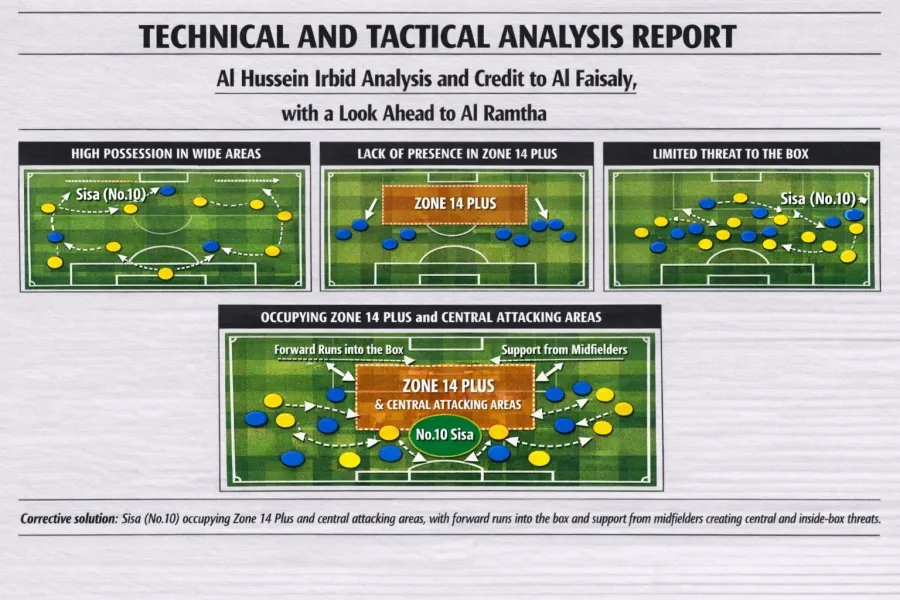
A central tactical issue in that match was the positioning of Sisa, Al Hussein’s number 10. Sisa drifted frequently into wide areas and deeper zones, at times appearing across almost every line of the pitch. While this movement helped ball circulation and allowed Al Hussein to dominate possession across the back third, middle third, and wide attacking zones, it also created a critical imbalance in the final phase of attack.
With Sisa vacating central attacking zones too often, Al Hussein lost consistent occupation of the space directly in front of the opposition penalty box. Possession remained high, but presence in decisive areas dropped sharply. Threat from Zone 14 Plus and central attacking areas in the front third, including inside‑box central lanes, was minimal. As a result, organised defensive blocks were able to stay compact, protect the penalty area comfortably, and defend without panic.
The match turned early when Muhannad Khairallah scored in the ninth minute following early pressing and decisive execution. That goal shifted both the psychological and tactical balance of the contest. From that moment on, Al Faisaly were content to concede possession in non‑dangerous areas, confident in their defensive structure and game management.
As Al Hussein increased tempo and pushed their midfield line higher, the same problem persisted. The ball circulated freely across wide and deeper zones, but without a stable central reference point occupying Zone 14 Plus and central attacking areas in the front third, attacks stalled. Crosses became predictable, deliveries into the box lacked numbers, and central defenders remained largely unchallenged.
From a tactical standpoint, the issue was structural rather than technical. Al Hussein’s problem was not effort, quality, or commitment, but positional occupation. Zone 14 Plus and central attacking areas in the front third, covering the half‑spaces just outside the penalty area, the central corridor at the top of the box, and the immediate inside‑box channels, are where high‑level matches are often decided.
The corrective solution is clear. Sisa’s role does not need restricting, but stabilising. Rather than roaming continuously, the number 10 must act as a central reference in Zone 14 Plus and central attacking areas in the front third, receiving between the lines, linking play under pressure, and drawing defenders inward.
Looking ahead to the clash with Al Ramtha, preparation will be just as important as tactical refinement. With almost three days between matches, recovery will be critical. Tactically, the match offers an opportunity to adjust the attacking dynamic by starting Al Mardi as either a false 9 or a central 9, before introducing Khadoon Sabra for the final 30 minutes. Keeping Sisa central as a number 10 would provide the necessary support and connection in central attacking areas.
Ultimately, the lesson is clear. At this level, football is not decided by how much of the ball a team has, but by how effectively it is used in the most dangerous spaces. Al Hussein Irbid remain one of the league’s most exciting sides, and how they apply these lessons against Al Ramtha may shape the next chapter of a title race that is very much alive.