
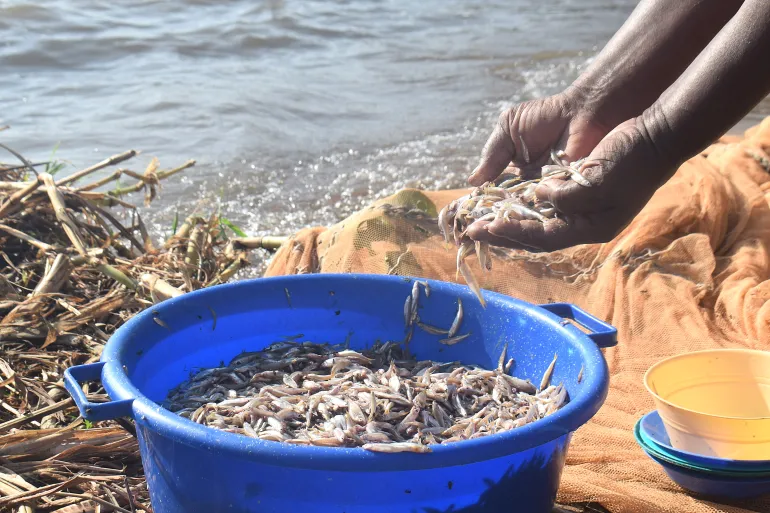
Jordan Daily - For decades, fishing in Lake Victoria villages was a male-dominated profession, but now women are breaking those barriers due to economic pressures and climate change.
Roda Ong’uchi Aketch, now in her 60s, recalls the whispers when she first set foot on a fishing boat in 2002. At 39, and a mother of seven, she was about to defy a long-standing social taboo: women were not allowed on fishing boats.
Aketch explained that her village believed that women joining men on the lake would lead to sexual relationships, but she persisted, proving she was there to learn. Eventually, the community accepted her.
In Kagwell village, Kisumu County, western Kenya, fishing was exclusively for men, while women bought and sold the fish. This division began to erode due to economic hardships, exacerbated by climate change, which is depleting the lake’s fish stocks.
William Okido, a 57-year-old village elder, noted that traditions were stricter concerning menstruation, believing a woman in that state would scare away fish. Even men were prohibited from marital relations before fishing trips.
Before 2002, Aketch was a fishmonger, but her income dwindled due to rising costs. Inspired by women from Homa Bay who were already fishing, she enlisted two young men to teach her. Despite warnings, she persevered for her family.
Aketch fished alone for 16 years before Faith Ower Angawo, a 37-year-old mother of four, joined her in 2018. Angawo, a former fish vendor, initially faced resistance from her husband but eventually gained his support.
By 2022, the sight of women fishing became commonplace. Janet Ndoyie, 42, faced no opposition when she joined, as the community had grown accustomed to Aketch and Angawo.
Wilson Ongulo, fisheries officer in the Simi sub-county, revealed that boat owners could earn between 6,000 and 8,000 Kenyan shillings (USD 46-62), while crew members earned 500 to 800 shillings (USD 3.88-6.20), surpassing the 500 shillings women earned from reselling fish.
Okido acknowledged the breakdown of social barriers, stating that economic difficulties are pushing women to defy taboos. Fisherman Delmas Onyango, 35, confirmed that most of his colleagues now support women’s decision to fish.
Aketch has observed a gradual decline in fish stocks over the past 23 years. Chris Mutai, a meteorologist in Kisumu, attributes this to climate change, which has increased water temperatures, promoted algae growth, and reduced oxygen levels. He anticipates a further temperature rise and advocates for protecting fish breeding grounds and halting pollution.
Lake Victoria supports over 42 million people who depend on it for food, work, and drinking water. However, it suffers from overfishing, pollution, and climate change, leading to a decline in individual shares despite an annual production of about one million tons of fish.
Despite their progress, women find themselves in a formal ambiguity. Susan Claire, acting director of fisheries and blue economy in Kisumu, stated that there are no women officially engaged in fishing, which deprives them of official support. However, Christopher Aura, director of freshwater research at the Kenya Marine and Fisheries Research Institute, reported in 2023 that the lake has over 47,000 fishermen, including 1,000 women, indicating a discrepancy in county data.
For Ndoyie, fishing revenues now cover her children’s university fees, which was previously difficult. However, the livelihood Aketch has carved out is becoming more fragile. Nevertheless, the four women continue to sail each dawn, finding that on scarce days, their income falls below that of fish selling, but on good days, it remains sufficient to justify the effort.
Aketch concludes with a local saying: "A man without land is a man without life," leaving its parallel unspoken: a fisherman without fish faces the same fate.