
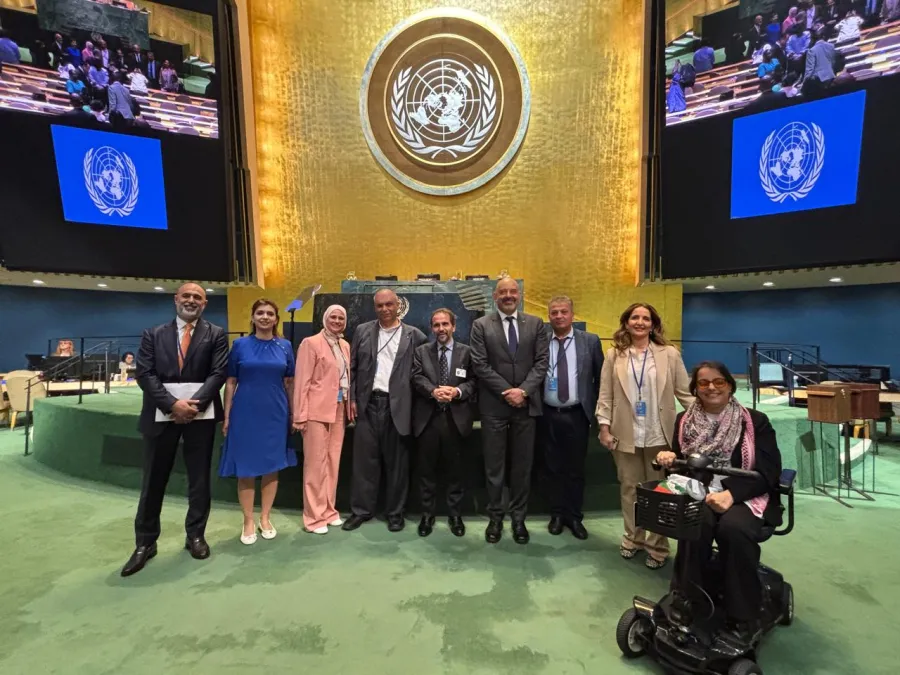
Jordan Daily - Dr. Muhannad Alazzeh has been re-elected to the United Nations Committee on the Rights of Persons with Disabilities (the CRPD Committee) for a second term spanning 2027–2030. The elections took place today at United Nations Headquarters in New York on the sidelines of the nineteenth session of the Conference of States Parties to the Convention on the Rights of Persons with Disabilities. Alazzeh secured (122) votes from participating States Parties.
Dr. Al-Azza secured re-election following a highly competitive electoral process that initially included 17 candidates. Following the withdrawal of two candidates, 15 contenders competed for 9 seats on the Committee. He was the only Arab candidate standing in this election.
Alazzeh is widely recognized as an independent expert in human rights and the rights of persons with disabilities. He possesses more than twenty years of experience in legal, human rights, and public policy fields. During his first term on the Committee, he assumed several key leadership roles, including Chair of the Working Group on the Committee’s Methodologies and Working Methods, where he contributed significantly to enhancing the Committee’s procedures and strengthening its engagement with States Parties and organizations of persons with disabilities.
He also served as Rapporteur for a number of States Parties to the Convention and participated in working groups focused on individual communications, the Optional Protocol, women with disabilities, and deinstitutionalization. In addition, he led the working group responsible for preparing the Committee’s report on the situation of persons with disabilities in Gaza and the Occupied Palestinian Territory.
Alazzeh’a re-election reflects the international community’s confidence in his expertise, professional competence, and contributions during his first term. It also underscores Jordan’s active presence within the international human rights system and the leading role the Kingdom continues to play in advancing the rights of persons with disabilities at the national, regional, and international levels.
Commenting on the election results, Alazzeh expressed his appreciation for the trust placed in him by the States Parties. He noted that his re-election represents a renewed responsibility to continue working with fellow Committee members, States Parties, and organizations of persons with disabilities to promote the implementation of the Convention on the Rights of Persons with Disabilities and to further strengthen the Committee’s work in protecting and advancing the rights of persons with disabilities worldwide.
Alazzeh extended his sincere gratitude to His Royal Highness Prince Mired Raad Zeid Al-Hussein, Lord Chamberlain and President of the Higher Council for the Rights of Persons with Disabilities, for his continuous support and confidence. He also expressed appreciation to all Council staff for the professional and technical support they provided throughout his first term and during the re-election process, emphasizing that this achievement reflects the strength of coordinated national efforts and the institutional excellence that distinguishes Jordan in international forums.
He further conveyed his profound appreciation to the Ministry of Foreign Affairs and Expatriates and to the Permanent Mission of the Hashemite Kingdom of Jordan to the United Nations in New York, represented by H.E. Ambassador Walid Obeidat and all mission staff, for the extensive diplomatic efforts undertaken in support of Jordan’s candidacy. He also acknowledged the support provided by the Minister of Social Development, H.E. Wafa Bani Mustafa, the League of Arab States, and fellow Arab countries throughout the election process.
The United Nations Committee on the Rights of Persons with Disabilities is the international body responsible for monitoring the implementation of the Convention on the Rights of Persons with Disabilities. It is composed of independent experts elected by the Conference of States Parties, who oversee States’ compliance with the Convention and contribute to the development and interpretation of international disability rights standards.