
Agencies - Israel struck an air base in northwest Syria early Tuesday, saying it aimed to prevent Turkish troops from deploying there.
Turkiye, which has close ties with the Syrian government and has been providing assistance to Syria’s military, has tense relations with Israel. The rival countries have sought to curb each other’s influence in neighboring Syria.
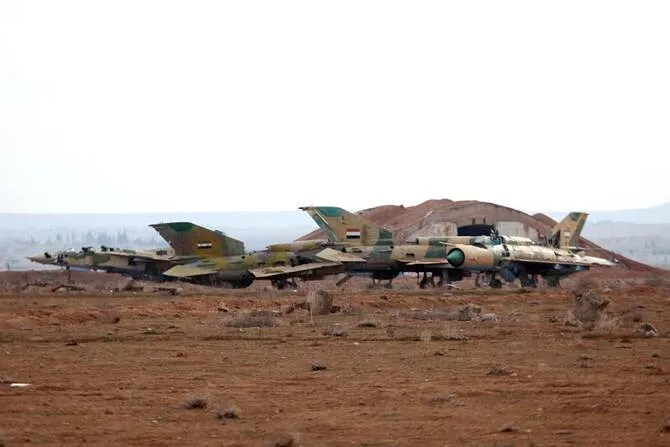
Eight strikes hit the runway of the Abu Duhur air base in the northwestern province of Idlib, causing damage but no casualties, state TV said. Syria’s Foreign Minister Asaad Al-Shibani told reporters in Damascus that Syria condemns the “Israeli aggression,” adding that the strikes were “an unjustified provocation, a violation of Syria’s sovereignty, and a direct threat to regional and global stability.”
Israeli Prime Minister Benjamin Netanyahu’s office said in a statement that Israel had attacked the base because Syria had been “on the verge of breaching” an agreed-upon “status quo in security matters” by allowing Turkish troops to deploy there.
“Israel repeatedly warned Syria that such a deployment would pose a threat to Israel’s security. Syria chose to ignore these warnings,” the statement said.
The Foreign Ministry of Turkiye condemned the attack in a statement and called for “the international community to take a more decisive stance to end Israel’s escalating aggression against Syria and to ensure accountability for these actions that disregard international law.”
The Britain-based Syrian Observatory for Human Rights, a war monitor, said foreign fighters used to stay at the base before they were recently asked to leave. The Observatory added that Turkiye, which is a main backer of Syria’s government, has been rehabilitating the air base that had been out of service for years during Syria’s conflict that left nearly half a million people dead.
Tom Barrack, the US ambassador to Turkiye and special envoy to Syria, posted on X that Washington is “deeply concerned that the confirmed Israeli airstrikes” on the Abu Duhur air base constitute “an unnecessary escalation that does not advance regional stability.”
The government of Syria’s Interim President Ahmad Al-Sharaa has neither “adopted a predatory posture nor maintained proxy forces” but has repeatedly indicated a preference for de-escalation with Israel, Barrack said.
The US has in the past hosted, and will continue in the future to host, discussions to encourage diplomacy, Barrack added.
Regional countries including Qatar, Egypt and Saudi Arabia also issued statements condemning the strikes.
Since the fall of Bashar Assad’s government in December 2024 when insurgents marched into his seat of power in Damascus, tensions between Israel and Turkiye over Syria have been on the rise.
Israel carried out hundreds of airstrikes around Syria after Assad’s fall, mainly destroying assets of the Syrian army to keep them out of the hands of his successors. The Israeli military also seized control of a UN-patrolled buffer zone in southern Syria, which it continues to occupy.
Israeli drone strikes on a southern suburb of Damascus last year killed eight soldiers and wounded others.
The new authorities in Damascus have said they do not want a conflict with Israel, but Israel has remained suspicious of the government led by former Islamist insurgents.
US-mediated talks between Israel and Syria aimed at reaching a security agreement have been ongoing for more than a year but have so far failed to produce a deal.
Security tensions heightened
Turkiye has rejected Israeli allegations that it posed a threat by preparing to send troops to a base in Syria, which was hit in a strike that the United States blamed on Israel.
“The frivolous allegations put forward by the Israeli Prime Minister’s office aim to legitimize Israel’s unlawful airstrikes targeting Syria’s sovereignty and territorial integrity,” Turkiye’s Communications Directorate said in a statement quoted by the Anadolu state news agency.
The strikes follow a heightening of security tensions between Israel and Turkiye and increasingly sharp rhetoric between the two countries over Syria.
Ankara has accused Israel of trying to destabilize Syria and undermine its new administration. Foreign Minister Hakan Fidan said on August 6 that Israel continued to threaten Syria’s security through its repeated attacks, calling for international pressure on Israel to respect Syria’s territorial integrity.
Turkiye, which has NATO’s second-largest army and recently signed a defense pact with Pakistan and Saudi Arabia similar to NATO, has become one of Syrian President Ahmed Al-Sharaa’s main allies. It has been training Syria’s army, helping it rebuild its state institutions and infrastructure, and providing it military and diplomatic support.
The Turkish ruling AK Party’s spokesperson Omer Celik said the strikes “showed once again that Israeli policies are the greatest enemy of peace and tranquility for the peoples of the region.”
“The entire international community must react to this together,” Celik wrote on X.
It was not immediately clear whether Turkiye was involved in renovating the base, but Ankara has said it was helping Damascus across the country.
Israeli Defense Minister Israel Katz has issued direct warnings to Turkish President Recep Tayyip Erdogan, saying Israel would not allow steps that strengthened Syria’s military capabilities in ways that could pose a threat to Israel.
Last year, Turkiye and Israel established a line of communication to avoid any incidents in Syria, where both of their militaries are active.
Syria conducted air exercises in the north of the country in early August using Russian-made MiG-21 fighter jets, the first such exercises since Assad’s ouster.
Israel’s Kan public broadcaster reported on August 11 that security officials had detected signs of Syria accelerating efforts to rebuild its air force, including the recruitment of new pilots, flight training and a first exercise involving fighter aircraft.
Kan quoted a security source as saying Israel had shared its concerns with the US.