
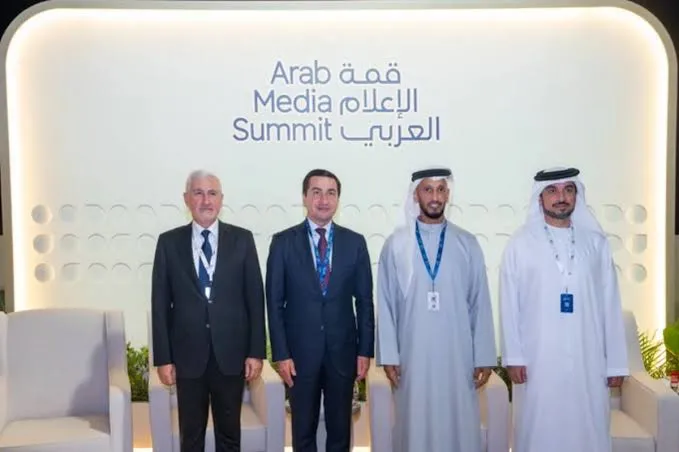
Jordan Daily - Azerbaijan’s presidential foreign policy aide Hikmat Hajiyev highlighted regional peace, cultural preservation and strategic partnerships during appearances at the Arab Media Forum and Arab Media Summit in the United Arab Emirates.
Hajiyev, assistant to President Ilham Aliyev and head of the Foreign Policy Affairs Department of the Presidential Administration, took part in a high-level panel in Dubai alongside Georgia’s foreign minister and the UAE’s minister of economy and tourism. The discussion was moderated by Euronews’ chief executive.
Hajiyev said Azerbaijan was seeking to strengthen its role across the South Caucasus, Caspian region, Central Asia, the wider Islamic world and the Middle East through closer regional cooperation.
He described Azerbaijan and the UAE as “like-minded partners”, saying their cooperation on development, security and regional stability could contribute to broader peace from the South Caucasus to the Middle East.
The Azerbaijani official also highlighted the country’s multicultural and religious heritage, including the legacy of Caucasian Albania and Christian monuments in Karabakh and elsewhere. He said Azerbaijan was committed to protecting and restoring cultural and religious sites regardless of their religious affiliation.
On relations with Armenia, Hajiyev described the peace process as difficult and requiring sustained political commitment. He said reconciliation would require broader public support and societies prepared for coexistence.
Hajiyev pointed to Azerbaijan’s coexistence of Muslim, Christian and Jewish communities as part of its historical identity, citing the presence of mosques, churches and synagogues.
He also stressed Azerbaijan’s role in European energy security through natural gas exports and highlighted the Middle Corridor, a trade route linking Asia and Europe, as an opportunity for greater economic integration.
Hajiyev called for balanced international engagement in the South Caucasus, saying outside policies should support regional cooperation and the interests of countries in the region rather than create new divisions.