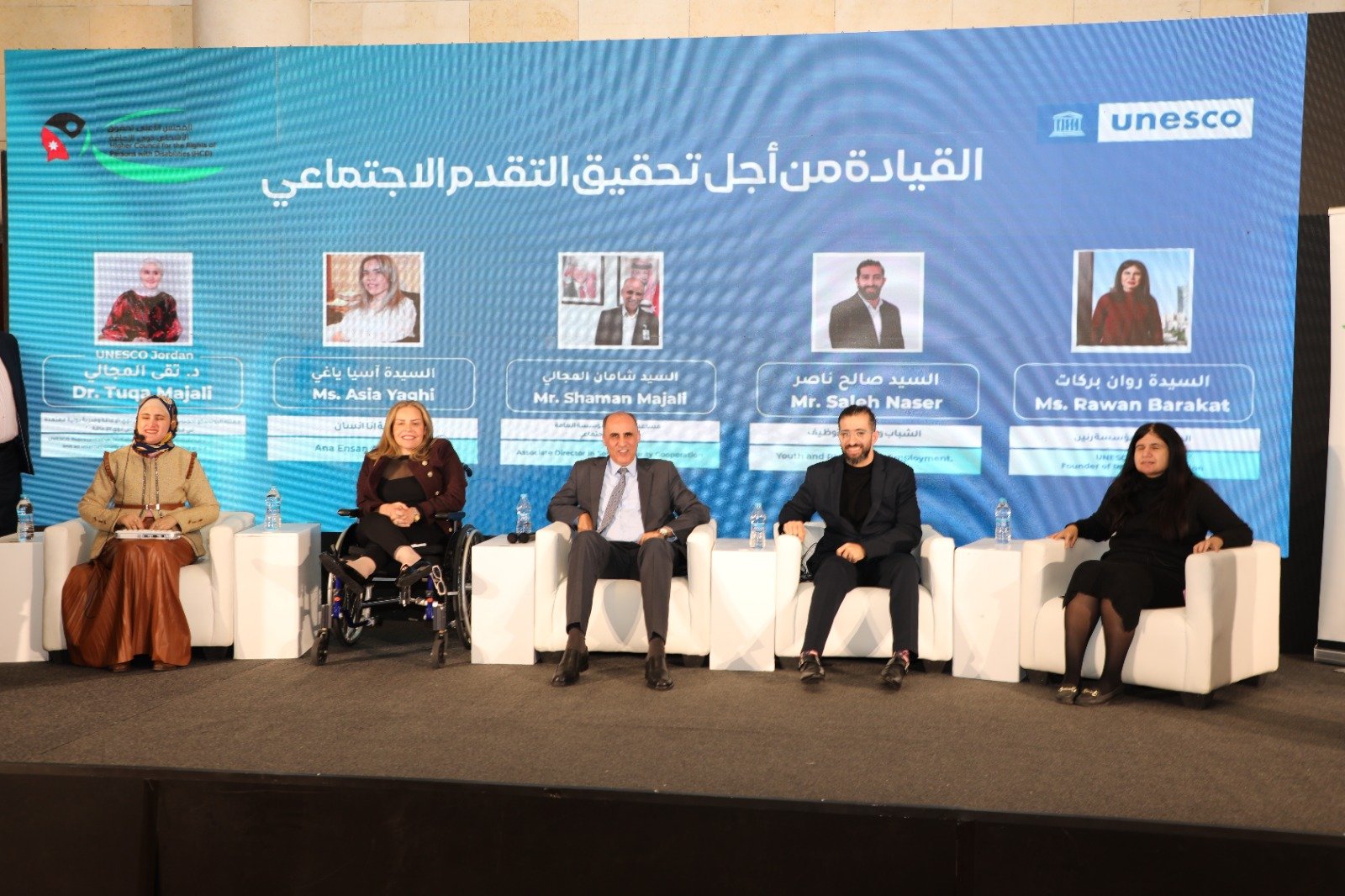
Jordan Daily - The Higher Council for the Rights of Persons with Disabilities (HCD), in cooperation with UNESCO, held a dialogue panel on Sunday to mark the International Day of Persons with Disabilities 2025, focusing on enhancing leadership in light of national commitments made at the Global Disability Summit.
The event, attended by government officials, private sector representatives and civil society actors, highlighted the need to empower persons with disabilities to play an active role in social progress and decision-making, while reviewing Jordan’s pledges to advance their rights, the HCD said in a statement.
UNESCO Representative and Head of the Education Programme Tap Raj Pant said persons with disabilities are drivers of social change, stressing that disability itself is not the barrier, but rather societal obstacles and lack of access. He noted that inclusion is a matter of justice and a cornerstone of sustainable development, pointing out that around one billion people worldwide live with disabilities yet remain excluded from equal opportunities and policymaking.
Pant reaffirmed UNESCO’s commitment to the UN Convention on the Rights of Persons with Disabilities, noting that the organization has developed an action plan this year to embed inclusion and accessibility across its work. He said Jordan is setting an example by translating Global Disability Summit commitments into action, particularly through efforts to make education accessible and ensure the participation of persons with disabilities in public life.
Dr. Zaid Atari, Director of Capacity Development and Research at HCD, said Jordan is moving from a welfare-based approach to a rights-based framework to guarantee equal access to education, health, employment and active citizenship. He noted that the Global Disability Summit, held with the participation of King Abdullah II, resulted in more than 130 commitments, describing the current phase as a “golden opportunity” to turn pledges into concrete results. He added that 60 national institutions have submitted implementation plans now being monitored by the Council.
The panel featured several speakers with disabilities who shared personal and professional experiences. Senator Asia Yaghi, Chair of the Senate Committee on Persons with Disabilities, emphasized the importance of education, legal awareness and political participation, saying representation in decision-making ensures fair and equitable policies.
Shaman Majali, spokesperson for the Social Security Corporation, spoke about overcoming workplace challenges and said determination and knowledge were key to his success, culminating in receiving the King Abdullah II Award for Excellence in Government Performance.
Other speakers included Rawan Barakat, founder of the Raneen Foundation, who highlighted inclusive education initiatives for blind children, and Saleh Nasser, founder of the Ablers project, which focuses on employment opportunities for youth with disabilities.
A second session, titled “Turning Commitments into Action,” brought together representatives from the Ministry of Education, the Housing Bank and Zain Jordan to discuss institutional inclusion, progress made and challenges in implementing national commitments.