
By : Nedal Zubeidi
Jordan Daily - The first challenge facing any government is not a lack of plans. Governments are rarely short of plans. They are short of trust.
Across the Arab world, citizens have grown accustomed to hearing promises, strategies, roadmaps, and visions. They have attended countless ceremonies announcing projects whose completion dates remain perpetually in the future. Over time, the distance between the government and the governed became not merely geographical, but psychological. The state spoke. The citizen listened. Neither was entirely convinced by the other.
Against this backdrop, the governing style adopted by Prime Minister, Jafar Hassan, deserves thoughtful examination.
I do not know the man personally, nor do I belong to the camp that celebrates governments for the sake of celebration. Governments are not football clubs. They are instruments of public service. They succeed, fail, and eventually pass. But fairness requires us to acknowledge what is visible before we debate what remains uncertain.
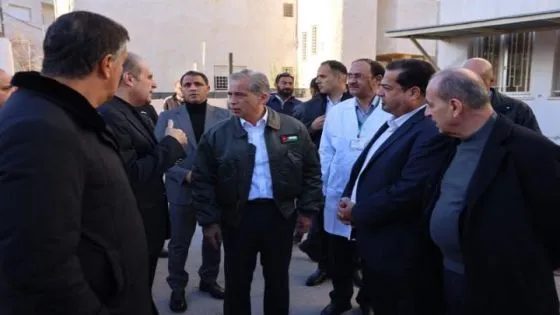
In less than two years, Jordanians have witnessed a pattern that has been relatively uncommon in recent governments: a prime minister who spends a significant amount of time outside the capital, visiting governorates, municipalities, schools, hospitals, industrial zones, investment projects, and remote communities. Reports indicate visits to more than fifty sites across ten governorates within the first months of his tenure, generating dozens of administrative and executive follow-ups.
The immediate question is obvious: so what?
In management theory, there is a concept known as "management by walking around." The idea is deceptively simple. Top officials often receive filtered information. Problems become smaller as they travel upward through bureaucratic layers. Reports are edited. Statistics are polished. Failures acquire explanations. Successes acquire a shine they may not entirely deserve.
This is why the question is not whether Jafar Hassan's visits matter. The real question is whether they are becoming part of a governing philosophy or merely a governing style.
If the visits result in faster decision-making, improved accountability, better service delivery, and the removal of bureaucratic obstacles, then they become more than symbolic gestures. They become instruments of governance. If they remain isolated events that generate headlines but not measurable improvements, they will eventually be forgotten.
The challenge facing Hassan, therefore, is not to continue visiting. It is to create systems that function even when he is not there.
Some journalists have criticized the prime minister intensely. Criticism is neither surprising nor undesirable. Public officials should expect scrutiny; indeed, they should welcome it.
When a government is absent from the field, the media criticizes its detachment. When a government appears constantly in the field, the media should not ignore that fact simply because it complicates a preferred narrative.
Unfortunately, much of the new media- globally, not only in Jordan-has become trapped between two temptations. One is public relations disguised as journalism. The other is opinion-driven commentary disguised as journalism. Both abandon the difficult work of objective observation.
A responsible press should be capable of saying two things: The prime minister's field engagement is unusual and noteworthy.
Jordan today faces challenges that no prime minister can solve through visits alone: unemployment, economic growth, public debt, investment competitiveness, regional instability, water scarcity, and the aspirations of a remarkably young population. None of these issues yield to good intentions alone.
Perhaps that is why the most interesting aspect of Jafar Hassan's tenure is not the number of visits he has made. It is the message those visits send about the relationship between authority and proximity.
For decades, Arab governance often projected distance as a symbol of prestige. The higher the office, the greater the separation. The citizen approached power through layers of bureaucracy.
Hassan appears to be experimenting with a different model: reducing the distance between decision-makers and the realities they seek to govern.
Whether that experiment succeeds remains an open question, but it deserves to be evaluated honestly.