

Jordan Daily - A new report on employment trends in Jordan during the first quarter of 2026 revealed that more than half of advertised jobs in the Jordanian labor market now require communication, language, and digital skills. This is a clear indication that a university degree alone is no longer sufficient to secure a job opportunity, and that the labor market is rapidly moving toward a model based on skills, practical experience, and technology. However, many jobs are still filled through traditional methods based on personal connections and are not advertised in newspapers or on digital platforms.
The report, issued by the Phenix Center for Economic and Informatics Studies,seen by Jordan Daily monitored job advertisements published in print newspapers and across various digital platforms. It showed that 53.3% of advertised jobs required communication and language skills, particularly English, while 51.5% required technical and digital skills. In addition, 47.4% of jobs required administrative, organizational, and project management skills, reflecting an accelerating shift in the nature of demand within the Jordanian labor market.
The report’s findings showed that digital platforms have become the main channel for job advertising, accounting for 69.4% of all monitored advertisements, compared with only 30.6% for print newspapers. The report considered these results to reflect the shift of Jordan’s recruitment market toward digitalization, while print newspapers continue to appear in some official and institutional job advertisements.
According to the report, LinkedIn ranked first among digital platforms, accounting for 23.9% of total advertisements, followed by Bayt at 14.5%, Tanqeeb at 10.1%, and Akhtaboot at 8.7%. This indicates that jobseekers increasingly need a professional digital presence and continuous follow-up of various online platforms.
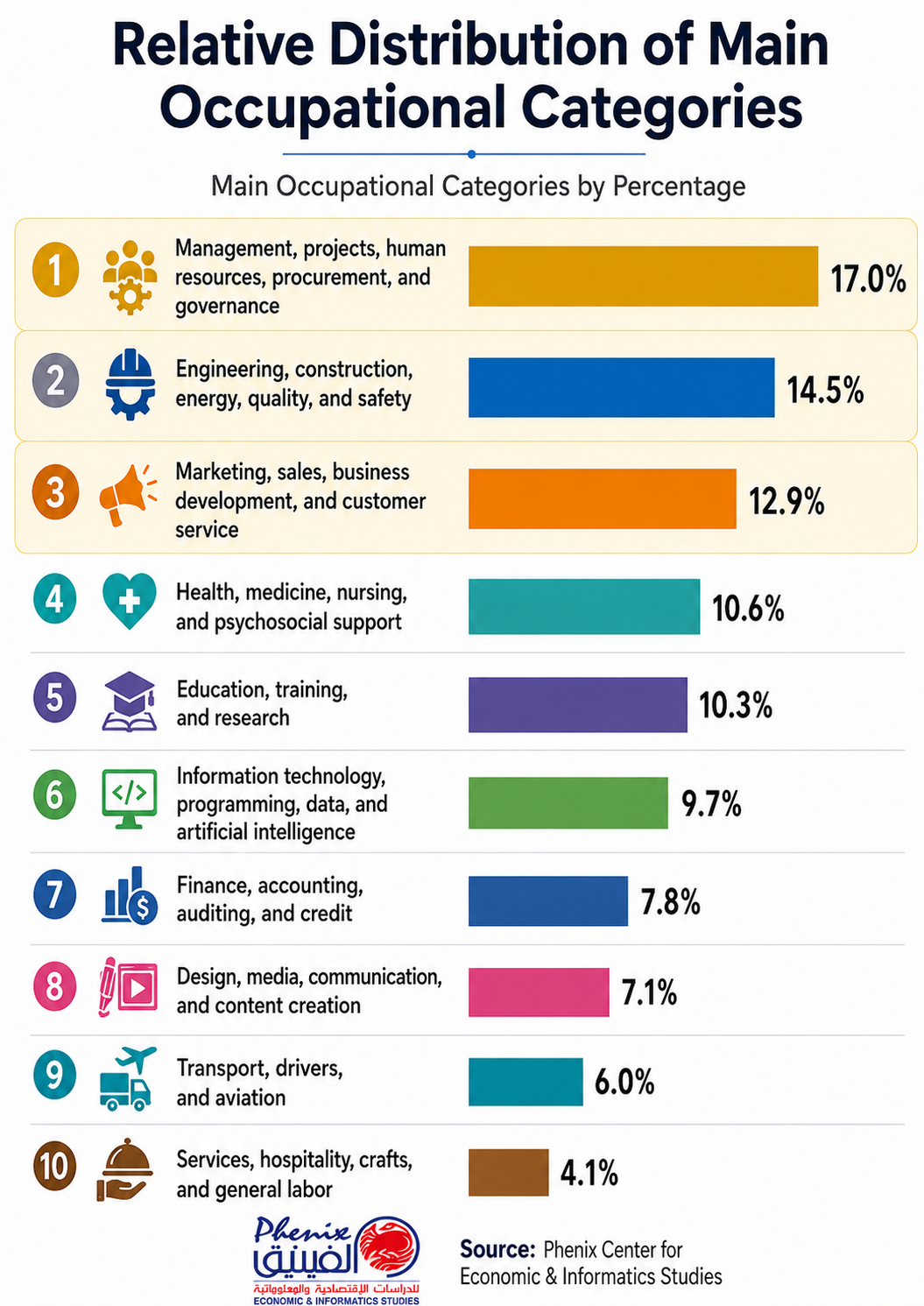
At the level of occupational categories, management, project management, human resources, and procurement jobs ranked first, representing 17% of total advertised jobs. They were followed by engineering, construction, energy, quality, and safety jobs at 14.5%, then marketing, sales, business development, and customer service jobs at 12.9%.
Relative Distribution of Main Occupational Categories
Main Occupational Categories | Percentage |
| Management, projects, human resources, procurement, and governance | 17.0% |
| Engineering, construction, energy, quality, and safety | 14.5% |
| Marketing, sales, business development, and customer service | 12.9% |
| Health, medicine, nursing, and psychosocial support | 10.6% |
| Education, training, and research | 10.3% |
| Information technology, programming, data, and artificial intelligence | 9.7% |
| Finance, accounting, auditing, and credit | 7.8% |
| Design, media, communication, and content creation | 7.1% |
| Transport, drivers, and aviation | 6.0% |
| Services, hospitality, crafts, and general labor | 4.1% |
Total | 100% |
The report also showed a strong presence of health, education, and technology-related jobs. Health, medicine, nursing, and psychosocial support jobs accounted for 10.6%, education, training, and research jobs for 10.3%, and information technology, programming, data, and artificial intelligence jobs for 9.7%.
The report considered these findings to reflect diversity in demand within the Jordanian labor market. Demand is not limited to digital jobs only, but also extends to traditional, professional, and service sectors, with a clear change in the nature of skills required within these sectors.
Regarding educational qualifications, the report revealed that 51.7% of advertised jobs required a first university degree, compared with only 9.4% requiring secondary education or its equivalent, 6.9% requiring a master’s degree or higher diploma, 5.7% requiring specialized certificates, 3.7% requiring a diploma or community college certificate, and only 2.5% requiring a PhD. Meanwhile, 1.1% did not require any formal qualification, only reading and writing skills, while 19% of jobs did not specify any educational certificate.
However, the report stressed that academic qualifications are no longer the sole decisive factor in recruitment, as most jobs now link university degrees with practical skills such as English language proficiency, digital skills, and project management.
In a notable indicator, the report showed that 37.5% of job advertisements did not specify a particular academic specialization. The report considered this evidence that part of the labor market is shifting toward a stronger focus on skills and practical experience rather than the title of the university major alone.
The data also revealed that English has become a key language in the advertised labor market, with 61.4% of advertisements published in English, compared with 38.6% in Arabic. The report linked this to the expansion of jobs in foreign companies, international organizations, technology sectors, and modern management fields, stressing that English has effectively become a “gateway skill” for accessing a wide range of job opportunities.
In terms of practical experience, the report showed that the labor market clearly tends to prefer candidates with medium and accumulated experience. Some 20.1% of jobs required experience ranging from five to less than seven years, while 19.4% required three to less than five years of experience. By contrast, only 21.6% of jobs did not require experience or welcome fresh graduates.
The report considered these results to reflect the continued “experience gap” facing young people when entering the labor market. This requires strengthening practical and applied training during university studies and linking education more closely to the actual needs of the labor market.
The report concluded with a set of recommendations, most notably redesigning university programs to link academic specializations with practical skills, expanding technical and vocational education, introducing mandatory practical training into study plans, and strengthening professional and workplace-oriented English language education.
The report also called on young people and jobseekers to focus on building marketable skills, such as communication, English language proficiency, digital skills, teamwork, and developing professional digital profiles that showcase their experience, projects, and applied and volunteer work.
In conclusion, the report affirmed that the Jordanian labor market is moving toward a new model that combines academic qualifications, skills, practical experience, language proficiency, and the ability to use technology. It noted that better job opportunities are increasingly linked to jobseekers’ ability to demonstrate their skills and adapt to changing work environments, rather than relying on academic credentials alone.