
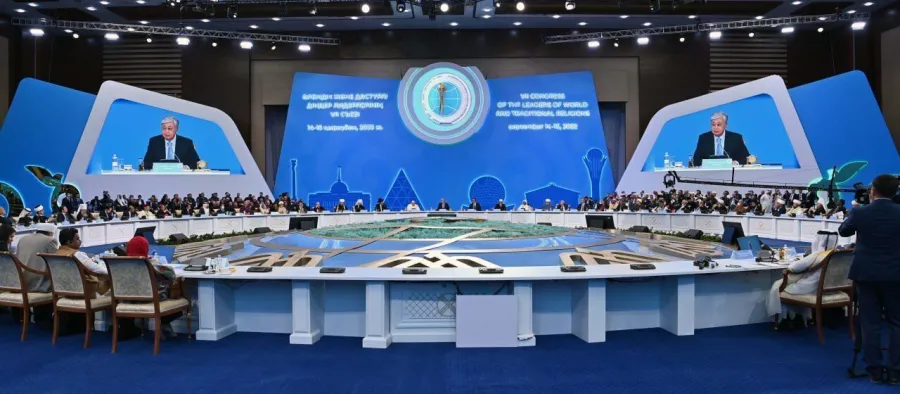
Jordan Daily - The Congress of Leaders of World and Traditional Religions has become one of Kazakhstan’s signature international initiatives, positioning the Central Asian nation as a platform for interfaith dialogue and diplomatic engagement amid rising global tensions.
The congress, launched in 2003 on the initiative of former President Nursultan Nazarbayev, convenes every three years in Astana and brings together religious leaders from Islam, Christianity, Judaism, Buddhism, Hinduism and other faiths. Its stated aim is to promote peace, tolerance and cooperation among civilizations through dialogue rather than confrontation.
Under current President Kassym-Jomart Tokayev, the congress has gained renewed diplomatic prominence as Kazakhstan seeks to expand its role as a mediator between East and West and as a center for “spiritual diplomacy.” Tokayev has repeatedly argued that religious leaders should play a larger role in addressing armed conflict, extremism and international mistrust.
Speaking at recent sessions of the congress, President Tokayev warned that geopolitical confrontation, sanctions and the risk of armed escalation threaten global stability, while calling for “constructive diplomacy” rooted in shared moral values. He has also proposed creating a global “Movement for Peace” under the auspices of the congress.
The congress is held at Astana’s Palace of Peace and Reconciliation, a pyramid-shaped building designed by British architect Norman Foster that has become a symbol of Kazakhstan’s interfaith outreach. Delegates typically include senior Muslim clerics, Christian patriarchs, rabbis, Buddhist representatives, political leaders and officials from international organizations.
One of the congress’s most closely watched gatherings was the seventh edition in 2022, attended by Pope Francis and other senior religious figures at a time of growing global instability following the COVID-19 pandemic. Participants adopted a declaration condemning extremism, terrorism and military conflict while urging stronger international cooperation and respect for religious diversity.
The VIII Congress in Astana culminated in the adoption of the “Astana Peace Declaration 2025,” which reaffirmed support for interreligious dialogue, peaceful coexistence and the protection of human dignity and cultural diversity.
The forum reflects the country’s multicultural identity and its ambition to maintain balanced relations with global powers while promoting itself as a neutral venue for dialogue, continuing to attract broad international participation and remains one of the most visible components of Kazakhstan’s foreign policy outreach under President Tokayev.