

Jordan Daily - The Phenix Center for Economic and Informatics Studies has called for the establishment of a national system that guarantees a minimum income for older people who do not receive any pension or regular source of income. The Center stressed that the presence of older people without regular income represents one of the most significant gaps in Jordan’s social protection system, making them more vulnerable to poverty, isolation, violence, and exploitation.
This call comes in a research report issued by the Center, which examines the state of social protection for older people, the main challenges they face, and a set of recommendations aimed at developing public policies and strengthening the rights of older people.
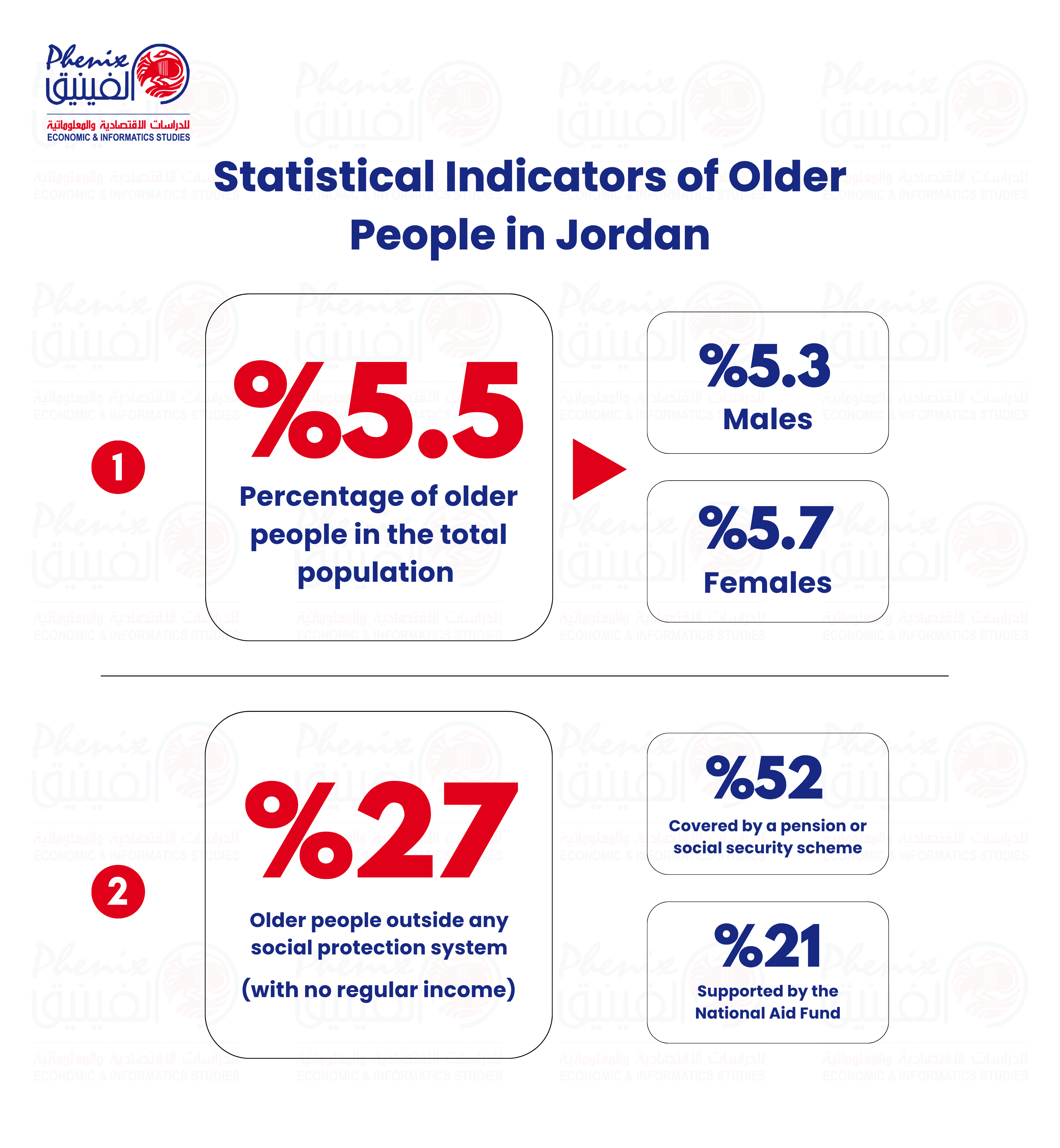
The report noted that Jordan is undergoing a rapid demographic transition, reflected in the gradual increase in the number of older persons. Jordan’s population stands at approximately 12 million, with people aged 60 and above accounting for 5.5 percent of the total population. This share is expected to rise to 16.6 percent by 2050, requiring a reorientation of public policies to develop social protection, health, and social care systems in ways that ensure a fairer and more sustainable response to their needs.
The report explained that some of the challenges facing older people stem from inequalities accumulated during their working lives. Many reach old age without adequate pension rights or any regular source of income due to employment in the informal sector, limited coverage by social security, or failure to meet the eligibility requirements for pension benefits. As a result, poverty in old age is often an extension of unstable work trajectories rather than a consequence of ageing itself.
The report found that only 52 percent of older people are covered by pension or social security systems, while 21 percent receive social assistance from the National Aid Fund or the Ministry of Social Development. Meanwhile, 27 percent remain outside both systems, without any pension income or social assistance.
It also showed that the average pension income is around JOD 400 per month, while older people estimate their basic needs at between JOD 500 and JOD 800 per month. This reflects a clear gap between available income and the cost of living.
The report also addressed economic violence as one of the key challenges facing older people. It indicated that some older people face pressure to give up their property or lose control over their money and financial rights, particularly in situations where they are highly dependent on others. This calls for stronger legal and economic protection for this group.
The report further noted that existing poverty support programmes, particularly the National Aid Fund, do not reach all older people in greatest need despite their importance. This is due to targeting criteria that may not adequately reflect their actual economic conditions, especially in cases where an older person owns non-income-generating assets or lives with a family member without having an actual income. The report therefore called for a review of eligibility criteria in a way that considers the specific circumstances of old age.
The report also highlighted the growing challenges of social isolation and neglect among many older persons, considering the demographic and social changes witnessed by Jordanian society, the decline of traditional care patterns, and the limited availability of home-based care and community support services. These factors affect the mental and physical health of older people and limit their inclusion in society.
In the same context, the report stressed that violence and abuse against older people are no longer limited to psychological and economic violence but may sometimes extend to physical violence. It pointed out that weak monitoring and reporting mechanisms, limited protection services, and the absence of a specialized legal framework limit the ability of institutions to prevent and respond effectively to such violations.
The report recommended adopting an integrated package of policies, foremost among them the establishment of a national system for older persons not covered by the various pension schemes; reviewing targeting criteria in cash assistance programmes; developing community-based and home-based care services; strengthening legal protection against economic violence and abuse; establishing a national system to monitor cases of violence and neglect; and expanding the database and research on the conditions of older persons.
The Phenix Center concluded its report by emphasizing that issues related to older people should be addressed from a human rights and social protection perspective, recognizing them as rights-holders rather than merely recipients of assistance. It stressed that ensuring their economic and social security is an investment in social justice and sustainable development and enhances their ability to live with dignity and independence and to participate actively in society.