By : Nedal Zubeidi
Chief Editor, Jordan Daily
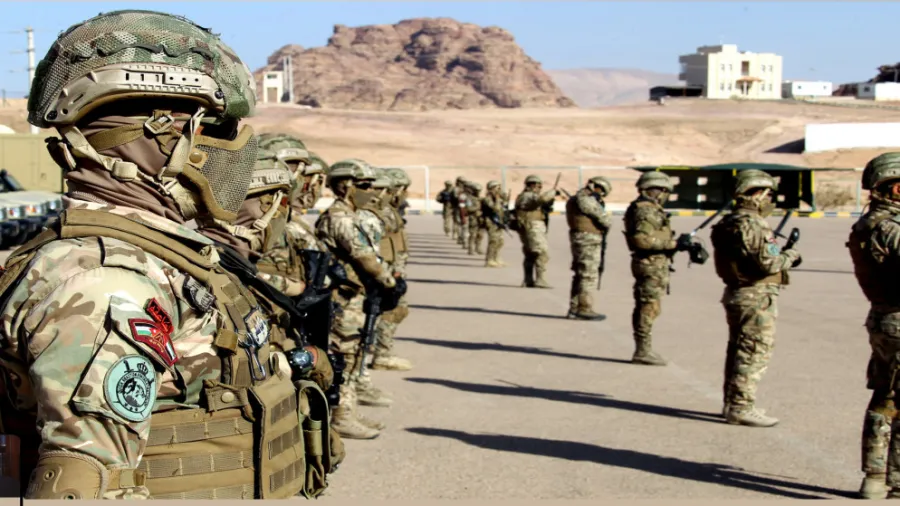
Jordan Daily - At moments of great transition, decisions are not measured by their immediate weight, but by their ability to anticipate what has not yet occurred. The letter sent by His Majesty King Abdullah II to the Chairman of the Joint Chiefs of Staff is neither a routine administrative directive nor a ceremonial declaration. It is, rather, an early reading of a world in which wars have changed faster than armies.
Geography is no longer the sole battlefield. Borders still matter, of course, but what unfolds behind screens, within cyber networks, and across energy and communications systems has become no less dangerous than the movement of tanks. The royal directive comes at a time of acute regional and international complexity, where old certainties are fading, traditional military doctrines are losing relevance, and new forms of warfare- hybrid, fast-moving, and multidimensional- emerge quietly, often striking before they are even recognized.
The structural transformation called for by the King is not a strategic luxury; it is an existential necessity. For armed forces to remain effective, strength alone is no longer sufficient. They must be agile. Training, by itself, is not enough; forces must possess the capacity to continuously relearn and adapt. This is the essence of the message: a shift from conventional readiness to comprehensive capability, where deterrence is built not merely on hardware, but on the cohesion of the entire system- from decision-making to execution, from the battlefield to information dominance.
The emphasis on maintaining sufficient, well-equipped reserve forces reflects a deep understanding of future conflict. In modern warfare, reserves are not numbers waiting to be mobilized in emergencies; they are flexible assets, activated at the right moment and managed with the logic of technology rather than the mentality of mass mobilization. Today’s reserve is knowledge, connectivity, and the ability to integrate rapidly into a constantly shifting operational environment.
Equally significant is the prioritization of defensive and offensive cyber operations. This is an explicit acknowledgment that sovereignty is no longer defined solely by control of territory, but by the ability to protect data, command-and-control systems, and critical digital infrastructure. In this invisible domain, wars can be won or lost before a single shot is fired. Cyber, as the royal directive makes clear, is not a technical add-on; it is a full operational domain requiring doctrine, skilled personnel, and disciplined governance- no different from land, air, or sea.
The message goes beyond restructuring to redefining military power itself. Protecting strategic and operational centers of gravity signals an understanding that the state is targeted as an integrated whole: its economy, energy, water, communications, and societal morale. Modern warfare, at its core, is a war of attrition against resilience and confidence before it becomes a battle of capabilities. Building a force capable of deterrence, therefore, cannot be separated from building a system capable of endurance.
What distinguishes this directive is that it comes from a commander with direct military experience, not theoretical familiarity. The language is precise, grounded in practice rather than abstraction. Time, in this context, is no longer measured in years but in cycles of innovation. The three-year roadmap set by the King to to achieve the structural transformation is less a deadline than a tempo- one that demands accelerated decision-making, intensive training, and the courage to reassess entrenched assumptions.
In essence, the royal message lays the foundation for a new chapter in the history of the Jordan Armed Forces- one in which modernization is a continuous process rather than a temporary project, and military thinking is open to all domains instead of confined to the lessons of the past. It is a call for an army that does not wait to see the shape of the next war, but actively participates in shaping it.